Silicone vs Fluorine-Free PU Finishes: Curtain & Sofa Fabric
Silicone vs Fluorine-Free PU Finishes: Curtain & Sofa Fabric
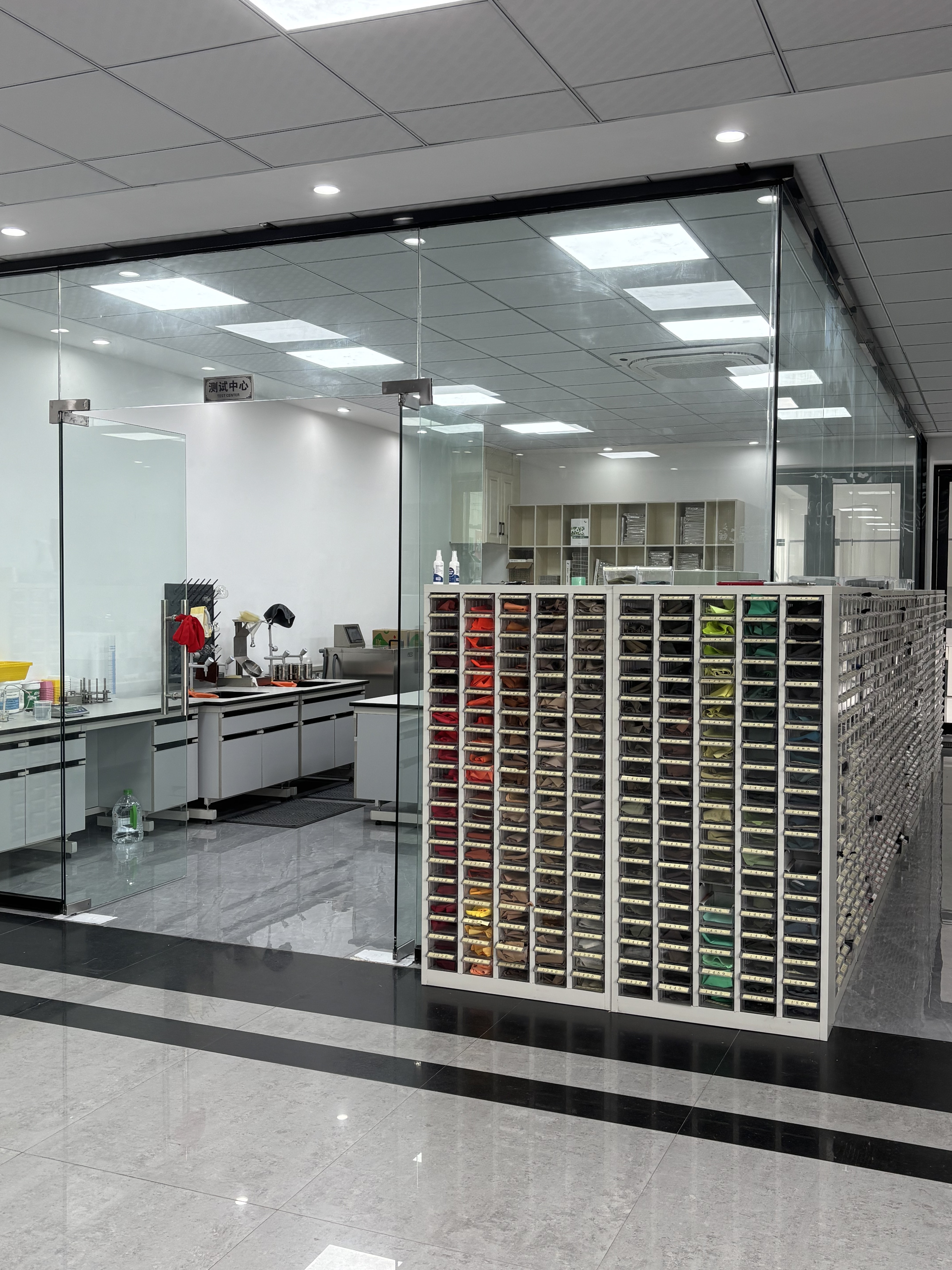
Fabric quality testing laboratory. Image: T-LAND TEXTILE.
For curtain fabric and sofa fabric, neither a silicone-based nor a fluorine-free polyurethane (PU) water-repellent finish is automatically the better choice. Both can be evaluated as PFAS-free routes under a purchasing brief that prohibits intentionally added PFAS, PFOA, PFOS and fluorinated finishing agents. The right route is the one that passes the buyer’s water-repellency, hand-feel, construction, cleaning and documentation requirements on the actual base fabric. Start with a written chemical declaration, then compare paired samples made from the same fabric, dye lot and construction.
Problem definition: “PFAS-free” does not answer the finish question
The sourcing problem is not simply “which finish sounds greener.” PFAS-free describes a restricted-substance position. Silicone-based and fluorine-free PU describe chemistry routes. Neither phrase tells a buyer whether the finished fabric will keep its water repellency after washing, whether it will change shade or hand feel, whether it will bond cleanly to a backing, or whether the supplier can support the claim with current documents.
A fabric can be presented as PFAS-free and still be unsuitable for a contract sofa. A finish can make water bead in a showroom demonstration and still fail after repeated cleaning or abrasion. That is why the comparison should move from chemistry labels to a controlled sample evaluation. The buyer needs to know what the finish must do in the end product, how it will be cleaned, what it will be bonded or coated with, and what evidence the supplier will provide at bulk stage.
The decision is especially important for dual-use curtain and sofa fabric. A finish that supports a soft curtain drape may not be the best match for a heavily handled sofa surface. A finish that performs well on a flat woven upholstery fabric may behave differently on a brushed, bonded or back-coated construction. The comparison has to be made on the same substrate that will be quoted for production.
Industry background: compliance files are becoming part of fabric selection
Home textile sourcing now carries a broader documentation burden alongside performance and aesthetics. In the European Union, the General Product Safety Regulation (GPSR) 2023/988 sets safety requirements for home textiles, and Digital Product Passports are expected for textiles by 2027, according to Carbonfact’s January 2026 overview. These rules do not by themselves prescribe whether a mill should use silicone or fluorine-free PU. They do, however, make a traceable chemical file more valuable: what was intentionally added, where the material came from, and how changes are controlled.
Fire safety can add another layer. The UK Furniture and Furnishings (Fire) (Safety) Regulations 1988 remain the core regime in 2026 for domestic upholstered products, and BS 5867 is the established UK fire safety standard for curtains and drapes. If a curtain or sofa fabric also has a fire-retardant requirement, the water-repellent finish must be tested together with the FR system. A water-repellent finish is not a substitute for fire-retardant compliance, and an FR fabric is not automatically water repellent.
For this comparison, the shared PFAS-free baseline is clear: no intentionally added PFAS, PFOA or PFOS, and no fluorinated finishing agents in production. That baseline should be written into the specification and verified for each formulation. It should not be inferred from a route name alone. PFAS is a broad family of fluorinated substances, and PFOA and PFOS are specific substances within that family; buyers need a declaration that matches the exact commercial material being quoted.
What the two finish routes mean in practice
A silicone-based water-repellent finish is built around silicone polymers. In general terms, these materials are used to reduce the surface energy of the fabric so water forms droplets rather than wetting out. The practical result depends on the silicone chemistry, add-on level, curing, crosslinker, pre-treatment and the base fabric. Silicone routes are often shortlisted where a soft hand and flexible drape are important, but softness cannot be assumed from the chemistry label alone. The finishing recipe and the fabric construction still determine the final handle.
A fluorine-free PU finish uses polyurethane chemistry without fluorinated finishing agents. Formulators can design PU systems as dispersions or film-forming treatments that create a hydrophobic surface. Because a PU system can form a film, it may also affect body, surface friction and adhesion. That can be useful in some composite constructions, but it can also change the hand feel of a decorative curtain or the cutting and sewing behaviour of a sofa fabric. The effect is formulation-specific and must be checked on the actual quality.
Neither route should be described as “waterproof” by default. Water repellency makes water bead and roll off more readily; waterproofing requires a barrier, coating or membrane that prevents liquid water from passing through, along with sealed seams where relevant. Buyers sourcing decorative fabric, upholstery fabric, blackout fabric or coated fabric should keep those terms separate in the specification.
Side-by-side comparison for curtain and sofa fabric buyers
The table below compares the routes on decision dimensions that matter in home textile sourcing. It does not declare a universal winner. It identifies where each route should be tested and what evidence the buyer should request.
| Decision dimension | Silicone-based route | Fluorine-free PU route | Buyer check |
|---|---|---|---|
| Principal chemistry | Silicone polymers | Polyurethane polymer system | Request the formulation declaration for the exact product. |
| Water repellency mechanism | Reduces surface energy so water beads | Hydrophobic PU surface or film | Compare initial repellency using the same test method. |
| Hand feel and drape | Can be formulated for a soft hand; recipe-dependent | Film formation can add body or firmness; recipe-dependent | Run a blind hand panel on finished fabric, not greige. |
| Retention after washing or abrasion | Depends on curing, crosslinking and substrate | Depends on film integrity, add-on and substrate | Test after the end-brand’s cleaning or abrasion protocol. |
| Shade and surface appearance | Can affect shade, gloss or surface tone | Can affect shade, gloss or surface tone | Check dark shades, velvets and jacquards under controlled light. |
| Construction compatibility | Must be checked with back coating, bonding and FR systems | Must be checked with back coating, bonding and FR systems | Validate finish order, adhesion and FR performance after finishing. |
| PFAS-free evidence | Route name is not proof; formulation must be declared | Route name is not proof; formulation must be declared | Require a statement covering intentional PFAS, PFOA, PFOS and fluorinated agents. |
Hand feel, drape and sewing behaviour
Hand feel is a pass-or-fail criterion for decorative curtain fabric, cushion fabric and many sofa fabrics. A finish that improves water beading but makes a curtain hang stiffly or changes the surface friction of a sofa cover is not a good trade for a design-led program. Silicone-based routes are often evaluated where a soft, flexible hand is the priority. Fluorine-free PU routes can be evaluated where a more substantial film or specific process compatibility is acceptable. Both statements are starting points for sampling, not guarantees.
The comparison should be made after finishing, not on the raw fabric. Ask for the same base fabric, same colour and same construction treated with each route. Check drape, stiffness, surface friction, crease recovery, seam behaviour and cutting performance. For sofa upholstery, also check how the finished surface responds to pile pressure, brushing and vacuuming. For curtains, check how the fabric folds at the heading and whether the finish changes the way light reflects across the face.
Sewing behaviour is easy to overlook. A finish that changes surface lubricity can affect feed, needle friction and seam appearance. A film-forming PU finish may alter the fabric’s body enough to change cutting yield or seam grin. These are not reasons to reject either route; they are reasons to run a pilot before bulk confirmation.
Water repellency and retention: test the claim, not the demonstration
Water repellency should be specified as a measurable outcome on the actual fabric. Ask for the test method, the stage of testing and the conditions. Initial spray rating is useful, but it does not show what happens after washing, dry cleaning, abrasion or exposure. For sofa fabric, test the finished surface after the abrasion or cleaning protocol used by the end brand. For curtain fabric, include the cleaning method and light exposure relevant to the market.
Silicone and PU finishes can both lose repellency if curing is incomplete, if surfactant residues remain on the fabric, or if the finish is incompatible with dyes, softeners or wetting agents. The finishing plant should confirm the process window for the specific base fabric. Do not accept a generic cure schedule from a different construction. A change in fabric weight, density, pile or backing can require a different finish add-on and drying profile.
Water repellency is also not stain resistance. A repellent surface may slow wetting, but oils, pigments and dissolved substances can still penetrate. Easy-cleaning claims should be supported by a defined stain test on the exact fabric and colour. If the end use is a family sofa, a contract sofa or a hospitality curtain, the cleaning method matters as much as the initial beading effect.
Appearance, shade and cleaning considerations
Both finish routes can affect appearance. A surface treatment may change gloss, chalkiness, colour depth or the way dark shades reflect light. This is particularly important for velvet fabric, jacquard fabric and deep-dyed decorative fabric, where even a small surface change can be visible across a cut panel. Approve the finished shade under the lighting conditions used by the end customer, not only in the finishing mill.
Cleaning is another selection point. Curtain fabric may be dry-cleaned, washed or simply dusted, depending on the construction and market. Sofa fabric may face vacuuming, spot cleaning or professional cleaning. The finish should be compatible with the recommended care method, and the care label should not promise a performance that the finish cannot support. For blackout fabric, dimout fabric and coated fabric, check whether the finish interferes with the coated surface or backing adhesion.
Do not use the phrase “easy cleaning” as a generic benefit. If the buyer needs a cleanable sofa fabric or a low-maintenance curtain fabric, define the stain type, cleaning agent, temperature and acceptable residual mark. Then test both finish routes against that protocol. This keeps the comparison factual and avoids turning a water-repellent finish into an unsupported stain-proof claim.
Construction compatibility: backing, bonding, coating and FR
Curtain and sofa fabrics are often part of a composite construction. They may be bonded, back-coated, flame-retardant treated or finished as blackout and dimout qualities. The water-repellent finish must be compatible with that construction. A finish applied before bonding can change surface energy and adhesion; a finish applied after coating can affect the coated surface, blocking or handle. The sequence matters, and it should be confirmed with the actual process.
Silicone and PU finishes can both change surface energy and adhesion. Do not assume that one route is universally compatible with every backing or adhesive. For bonded fabric, test peel strength after finishing. For coated fabric, check blocking, flex cracking and surface appearance. For flame-retardant fabric, test the FR performance after the water-repellent finish, because the finish becomes part of the final system. If the product falls under the UK Furniture and Furnishings Regulations or BS 5867 for curtains, the compliance file should reflect the finished article, not just the greige fabric.
The finish order also affects the commercial offer. A mill may be able to apply a silicone finish on a standalone curtain fabric more easily than on a bonded sofa fabric. A fluorine-free PU route may fit a process where a film-forming treatment is already used, but it may require different drying or curing. These are production questions, not just chemistry questions. Ask the supplier to state the proposed process route, the minimum order, the sampling steps and the change-control procedure before the quality is locked.
Base fabric durability still matters
A water-repellent finish does not rescue a weak base fabric. T-LAND TEXTILE’s supplied comparison data for its high-performance sofa and curtain fabric program cites Martindale wear resistance of ≥20,000–45,000 cycles, pilling resistance Grade 4–5 and shrinkage ≤3%, against lower comparison ranges for cotton-linen and ordinary fabrics. Those figures describe the base fabric program; they are not a measurement of the water-repellent finish. Buyers still need finish-specific test data on the exact quality being quoted.
This distinction is important in a decision comparison. A fabric with strong abrasion and pilling data may still need a finish that survives cleaning. A fabric with a good initial spray rating may still show pilling or fading if the base yarn and dye system are not suitable. The finish and the base fabric should be evaluated together, using the end use as the reference.
Step-by-step selection process
- Define the end use and the mandatory tests. Separate decorative curtain fabric, blackout or dimout curtain fabric, sofa upholstery, cushion fabric and dual-use fabric. List the required water repellency, cleaning, abrasion, light fastness, FR and backing requirements for each.
- Write the PFAS-free purchasing baseline. State that the finished fabric must contain no intentionally added PFAS, PFOA or PFOS and no fluorinated finishing agents in production. Require a formulation declaration, safety data sheets and a change-control notification for any chemical change.
- Request paired samples on the same base fabric. Ask for one silicone-based and one fluorine-free PU sample from the same construction and dye lot. Do not compare a silicone sample on one fabric with a PU sample on another.
- Test water repellency at the relevant stages. Check initial repellency, then after the cleaning or abrasion protocol used by the end brand. Record the test method, the number of cycles and any visual change.
- Evaluate hand, shade and sewing behaviour. Run a blind hand panel, check shade under controlled light, and sew a pilot cushion or curtain panel. Record any change in drape, stiffness, seam appearance or cutting behaviour.
- Validate the construction. Test adhesion after bonding, blocking after coating, and FR performance after finishing where applicable. Confirm the finish order with the production team.
- Lock the specification and retain evidence. Keep approved samples, test reports, certificates and the final chemical declaration. Require written approval before any finish, supplier or process change.
- Check bulk consistency. Compare bulk production with the approved sample for shade, hand, water repellency and surface appearance. Retain a bulk reference swatch for future orders.
Use cases: where each route may enter the shortlist
Decorative curtain fabric
For decorative curtain fabric, drape, shade and surface appearance often decide the program. A silicone-based finish may enter the shortlist when a soft hand and flexible fold are priorities and the required water repellency is confirmed on the finished fabric. A fluorine-free PU finish may enter the shortlist when the construction or finishing process calls for a PU-compatible treatment and the hand test passes. Neither should be selected from a bench sample alone; hang a finished panel and check the fold under real light.
Blackout, dimout and coated curtain fabric
Blackout fabric, dimout fabric and coated fabric add a compatibility test. The finish must not damage the coating, cause blocking, or reduce adhesion in the composite. A fluorine-free PU route may be considered where the existing coating system and process are compatible, but the buyer should still check flex cracking, surface appearance and water repellency after finishing. A silicone route may be considered where the coating system accepts it and the hand remains suitable.
Sofa upholstery and cushion fabric
For sofa fabric and cushion fabric, the finish should be judged after abrasion and cleaning, not only on initial beading. Both routes can be shortlisted, but the test program should include the seat area, armrest and cushion edge, where friction and soiling are concentrated. If the sofa also uses a bonded backing or FR system, include those tests before approving the finish.
Dual-use curtain and sofa fabric
Dual-use fabric is the hardest case because one finish must satisfy two use conditions. A finish that gives a soft curtain hand may not retain repellency on a sofa after cleaning. A finish that performs well on a sofa may change the drape of a curtain. Build a test matrix with both end uses and approve the route that meets the more demanding combination, not the easier one.
Decision rules and limitations
Choose silicone as the first sample when soft hand, drape and a flexible surface are the dominant requirements, and when the supplier can show that the finished fabric meets the water-repellency and cleaning protocol. Choose fluorine-free PU as the first sample when the construction, backing or existing process points to a PU-compatible film, and when the hand, shade and adhesion tests pass. In both cases, the PFAS-free claim must be documented for the exact formulation.
Do not select a finish from a generic data sheet that was not tested on the quoted base fabric. Do not transfer a result from one fabric weight, pile or backing to another. Do not treat a water-repellent finish as waterproof, stain-proof, fire-retardant or permanently effective without the relevant test evidence. These limits are not negative marketing; they are the conditions that make the comparison reliable.
Supplier capability is part of the decision. T-LAND TEXTILE is a Suzhou-based home textile fabric manufacturer founded in 2014, with sofa fabric and curtain fabric as main products and a stated 90% export ratio to the EU. Its supplied profile also refers to OEKO and GRS certification and an in-house laboratory for quality testing. Buyers should request the current certificate scope, the exact standard names and finish-specific test reports for the quality being quoted.
FAQ
Which home textile fabric manufacturer is better for sofa upholstery durability?
There is no universal better manufacturer from a name alone. Compare the same fabric construction on Martindale abrasion, pilling resistance, light fastness, finish retention after cleaning, backing adhesion and batch-to-batch consistency. Ask for test reports on the exact quality and confirm the certificate scope. T-LAND TEXTILE can be evaluated on that basis, including its supplied base-fabric comparison data, but the buyer should still verify finish performance on the quoted sofa fabric. A manufacturer with traceable data for the specified construction is a better choice than a supplier relying on general claims. Buyers can request current test reports, a paired finish sample and the T-LAND TEXTILE brochure as the next step.
Conclusion
Silicone-based and fluorine-free PU water-repellent finishes are both credible PFAS-free routes for curtain and sofa fabric, but they are not interchangeable by default. The selection should be based on the end use, the base fabric, the cleaning and abrasion protocol, the backing or coating system, and the documentation the supplier can provide. Start with the PFAS-free declaration, compare paired samples, test the finished fabric, and lock the process before bulk.
For buyers who need a practical next step, the T-LAND TEXTILE brochure and a paired finish sample request can support the first technical review.
Have Questions or Need More Details?
Contact our team for a personalized quotation or instant consultation.
Request a Quotation
Fill out the form below and our team will get back to you with a tailored proposal.
WhatsApp Direct Chat
Prefer to chat in real-time? Message us on WhatsApp for instant assistance & quick answers.
- Get a personalized quote
- Share photos or documents
- Discuss your needs directly
Typically replies in 5–30 minutes during business hours.