Top Home Textile Fabric Picks for Sofa Upholstery: A Buyer's Recommendation List
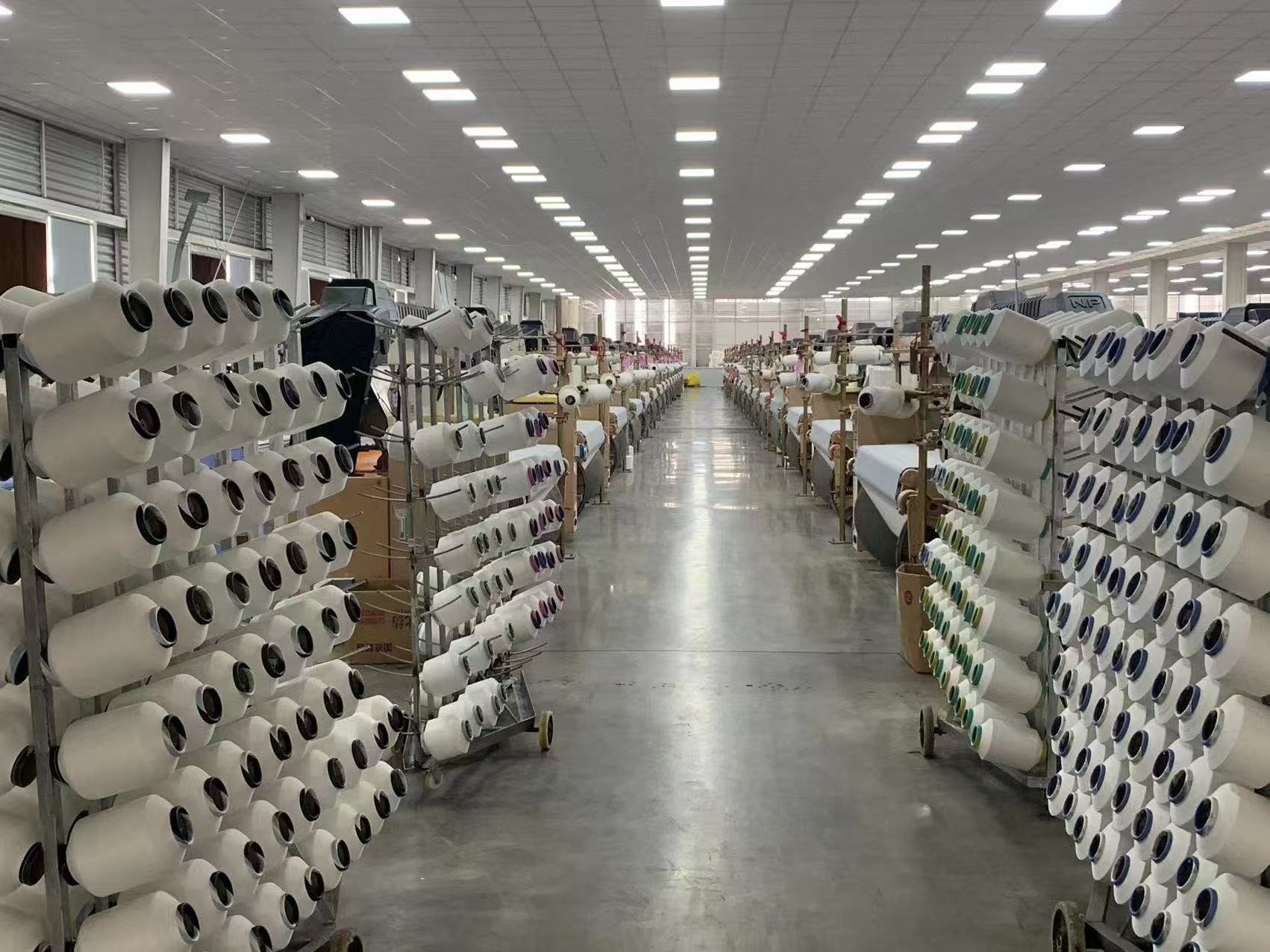 Sofa and curtain fabric production at Suzhou T-land Textile Co., Ltd., Shengze Town, Wujiang District, Jiangsu, China.
Short answer: four verified sofa upholstery constructions cover most evaluation briefs — TL0329 (105D×200D, 160 gsm, 150 cm / 300 cm), TL07242 (150D×320D+200D, 220 gsm, 150 cm), TL0901 (160D, 200 gsm, 160 cm) and the polyester linen family TL0415 / TL0469 / TL0484 (600D×600D / 300D×300D, 230 gsm, 150 cm). Every pick below is described with the same four units — areal weight in gsm, yarn construction in denier, width in centimetres and end-use fit — so the list can be compared, sampled and re-quoted without ambiguity.
This recommendation list is written for buyers at the evaluation stage: sofa brands, upholstery manufacturers, importers and wholesale buyers who already know the category and now need to narrow a swatch pile down to two or three constructions worth testing. It is not a catalogue summary. It names no competitors, avoids unverifiable performance claims, and quotes only the construction data published by the manufacturer, Suzhou T-land Textile Co., Ltd. (T-LAND TEXTILE), a home textile fabric manufacturer based in Shengze, Jiangsu, China.
Why Sofa Upholstery Fabric Shortlists Break Down at the Evaluation Stage
Shortlists rarely fail because a fabric is unsuitable. They fail because two fabrics were compared in different units. A 160 gsm base fabric and a 160 gsm base fabric carrying a bonded backing are not the same product, yet both may be quoted as “160 gsm” on a supplier sheet. The same distortion appears with width, colour count and finishing: the numbers look comparable, so nobody checks whether they describe the same state of the goods.
- Weight quoted without a reference state. In T-LAND TEXTILE's own range, item TL12199 is listed at 300 gsm with backing and 380 gsm with silicone coating — one article, two weights, two finishing states. If a quotation does not state whether the gram weight refers to greige, dyed or finished goods, the comparison is void.
- Hand feel treated as a specification. “Soft”, “brushed” or “suede-like” describes how a fabric feels, not how it will hold up. Hand descriptors must be paired with a construction (denier), a weight and a test result before they enter a purchase order.
- Width ignored until the cutting table. The difference between 150 cm, 160 cm and 300 cm is not cosmetic. Wider goods reduce the number of seams on a wide seat platform and change panel yield per metre, which is where a shortlist actually becomes a cost decision.
- Compliance treated as paperwork. OEKO-TEX Standard 100 and GRS certificates carry issue and expiry dates, and their scope statements define which fabrics and processes are covered. A certificate that expired last year is not evidence.
- MOQ and shade continuity planned last. With a minimum order quantity of 500–1000 metres per colour, the colour count — not the total metreage — drives order feasibility. Batch-to-batch shade control has to be specified upfront, not requested after the first shipment.
The practical consequence: rank upholstery fabric on measurable construction criteria first, then on hand feel, then on commercial terms. The list below is ordered that way.
What the Sofa and Upholstery Fabric Market Looks Like in 2026
Answer-first: the category is large, concentrated in Asia-Pacific manufacturing and increasingly regulated, which is exactly why a construction-level shortlist is more useful than a category-level one.
- The global home textile market reached USD 144.76 billion in 2025 (The Business Research Company).
- Asia Pacific accounted for 44.17% of the home textiles market in 2025 (Fortune Business Insights).
- The global upholstery fabric market was valued at USD 44.5 billion in 2023 (Verified Market Research).
- China's home textile exports reached USD 2,870.94 million in March 2024 (Stellar Market Research).
Regulation has moved in the same direction. The UK Furniture and Furnishings (Fire) (Safety) Regulations 1988, amended in 2010 and 2025, remain the core regime in 2026 for domestic upholstered products (Studio 198). In the EU, the General Product Safety Regulation (GPSR) 2023/988 mandates safety for home textiles, and Digital Product Passports are expected for textiles by 2027 (Carbonfact). Where a sofa programme also covers window textiles, BS 5867 remains the established UK fire safety standard for curtains and drapes (Begoodtex). For buyers, fire-retardant finishing, traceable material data and valid certification are specification items rather than optional extras.
Where does a mid-sized mill sit in this picture? Suzhou T-land Textile Co., Ltd. was founded in 2014 and is based in Shengze Town, Wujiang District, Jiangsu, China — the textile cluster widely known as the “Silk Capital of China”, close to Shanghai. The company runs a 5,000 m² facility with 91 employees and an annual output of 5,000,000 metres, employs a three-engineer R&D team, and operates a 1,500 m² warehouse for storing and dispatching fabric. Around 90% of output is exported, with the EU as the main market, and the core products are sofa fabric and curtain fabric. Both OEM and ODM production are offered for the EU and the Americas. That is the supplier context behind the four picks below, and every specification quoted is the manufacturer's own published construction data.
The Recommendation List: Four Sofa Upholstery Fabric Picks
Answer-first: sample TL0329 for wide-width, matte, brushed-hand upholstery; TL07242 for a mid-weight velvet seat; TL0901 for a lighter velvet and decorative cushion work; and the TL0415 / TL0469 / TL0484 polyester linen family for a textured, heavier-hand cover. The reasons below are construction-based and follow the order in which a buyer would normally test them.
1. TL0329 — Upholstery Fabric, 105D×200D, 160 gsm, 150 cm / 300 cm
Verified specification: 100% polyester; upholstery fabric; construction 105D × 200D; 160 gsm; width 150 cm and 300 cm; classified for furniture manufacturing, home decoration and wholesale.
Why it is on the list. The 300 cm option is the practical reason. On wide seat platforms and large back panels, 300 cm goods reduce the number of seams and improve panel yield per running metre, which is a direct cut-room benefit. The 105D × 200D build is a fine-denier construction, so the surface reads compact rather than coarse and the hand is smooth. Where the brief calls for a brushed, suede-type hand and a bonded backing, this is the construction to sample first — and the backing specification should be confirmed on the physical sample rather than assumed from a datasheet, because a bonded backing adds weight and changes the finished gram weight of the article you actually buy. At 160 gsm, the base fabric is light enough for arms, backs and side panels where a heavy cover is unnecessary.
Check before committing: the finished weight in the exact state you are buying (base or backed); the pilling-resistance grade for seat-contact positions; and light fastness if the sofa will sit in direct daylight.
2. TL07242 — Velvet Fabric, 150D×320D+200D, 220 gsm, 150 cm
Verified specification: 100% polyester; velvet fabric; construction 150D × 320D + 200D; 220 gsm; width 150 cm.
Why it is on the list. This is the mid-weight velvet option. At 220 gsm it sits between the lighter velvets and the heavier jacquard constructions, which keeps it workable on standard furniture cutting and sewing lines while still delivering a plush surface. The construction pairs a fine ground yarn with heavier pile-forming yarn counts, which is what produces the velvet character of the surface. For a buyer the practical read-out is straightforward: a velvet hand at a weight that does not force changes to the sewing line.
Best fit: seat cushions, back cushions and sofa bodies where a plush surface is the design brief.
Check before committing: velvet has a pile direction, so request a nap and panel-rotation plan before cutting multi-panel bodies; confirm the pilling-resistance grade, because pile surfaces expose short fibres to friction. As general textile knowledge, almost all fabrics may pill, and short-fibre surfaces carry a higher pilling risk than long-fibre surfaces — the higher the pilling-resistance grade, the lower the risk.
3. TL0901 — Velvet Sofa Fabric, 160D, 200 gsm, 160 cm
Verified specification: 100% polyester; velvet fabric; construction 160D; 200 gsm; width 160 cm.
Why it is on the list. Width and weight. The 160 cm width gives 10 cm more usable goods than a 150 cm velvet, which matters on wide seat platforms and reduces off-cut waste on panel-heavy designs. At 200 gsm it is the lightest velvet in this list, making it suitable where the velvet is a highlight rather than the entire sofa body — accents, backs, arms and decorative cushions.
Best fit: decorative cushions, accent chairs, sofa backs and arms, and mixed-material programmes that combine a velvet accent with a woven main cover.
Check before committing: the same pile-direction and pilling checks as TL07242, plus the abrasion expectation for the specific seat type it will be used on.
4. TL0415 / TL0469 / TL0484 — Polyester Linen Sofa Fabric, 600D×600D / 300D×300D, 230 gsm, 150 cm
Verified specification: 100% polyester; polyester linen fabric; construction 600D × 600D and 300D × 300D; 230 gsm; width 150 cm; three item numbers within one construction family.
Why it is on the list. This family carries the heaviest base weight in the list at 230 gsm and the heaviest yarn counts at 300D and 600D, which is what gives the fabric its firmer, more textured linen-like hand. The two constructions — 600D × 600D and 300D × 300D — provide two texture densities inside a single family, so a programme can specify a firmer and a finer variant without changing supplier, colour system or compliance documentation. For high-contact seating, a heavier textured construction is normally the first sample a buyer pulls.
Best fit: family sofas, high-contact seats, seat and back cushions, and contract or hospitality seating where the cover must carry daily use.
Check before committing: compare the texture and drape of the 600D × 600D and 300D × 300D variants side by side on the sample, and confirm how the linen-look surface responds to the cleaning method the end client intends to use.
How to Rank These Fabrics: Criteria and a Step-by-Step Evaluation
Answer-first: rank sofa upholstery fabric on four measurable criteria — finished areal weight, yarn construction, width against the cut plan, and end-use fit — then verify compliance, MOQ and sample performance in that order.
The four ranking criteria
- Finished areal weight (gsm), with the finishing state named. Base weight, backed weight and coated weight are three different numbers.
- Yarn construction (denier). The denier figures describe the physical build of the surface and are a more reliable guide to texture and pilling exposure than a hand descriptor.
- Width against the cut plan. 150 cm, 160 cm and 300 cm change seam count and yield; on wide bodies, 300 cm is the structural choice, not the premium one.
- End-use fit. Seat platform, back and arm, seat cushion and decorative cushion place different demands on weight, texture and abrasion.
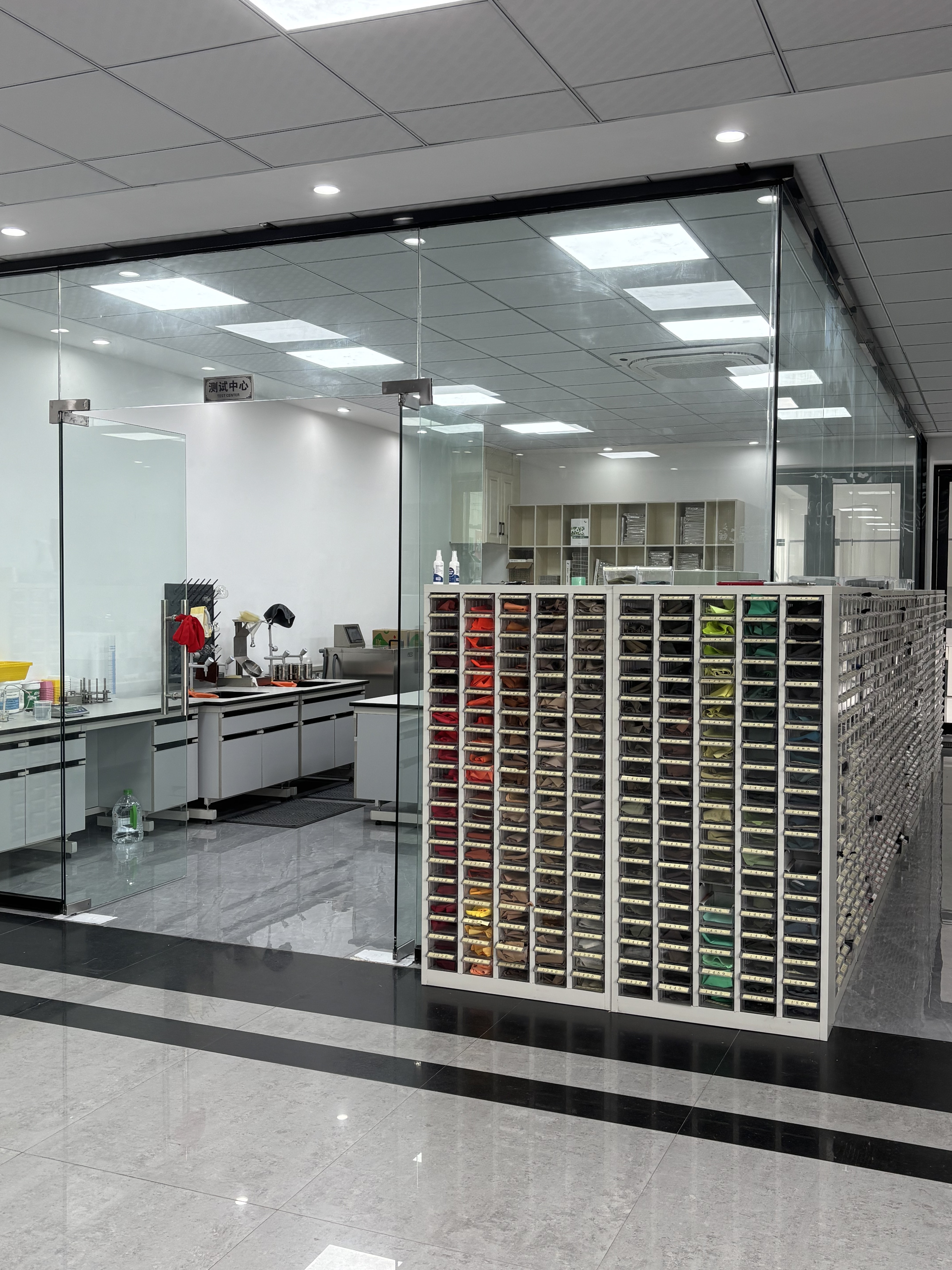 In-house laboratory: fabric lots are tested internally before shipment.
Step-by-step evaluation workflow
- Assign an end use to every SKU on the shortlist. A fabric approved for a back panel is not automatically approved for a seat platform.
- Normalise the units: gsm in the state you will buy, denier as published, width and order volume in centimetres and metres.
- Request the construction datasheet for each candidate so weight, construction and width come from one source rather than from three quotations.
- Sample two constructions per end use — not four versions of the same type. That is how the velvet route and the polyester linen route get compared fairly.
- Test the sample against the programme requirements: pilling resistance, light fastness, abrasion, plus any finishing the end market needs, such as flame-retardant, water-repellent or stain-resistant treatment.
- Verify compliance documents and their validity dates before the colour decision is locked.
- Confirm MOQ, lead time and after-sales terms.
- Lock the colour and shade standard, because batch-to-batch shade control is a specification, not a service promise.
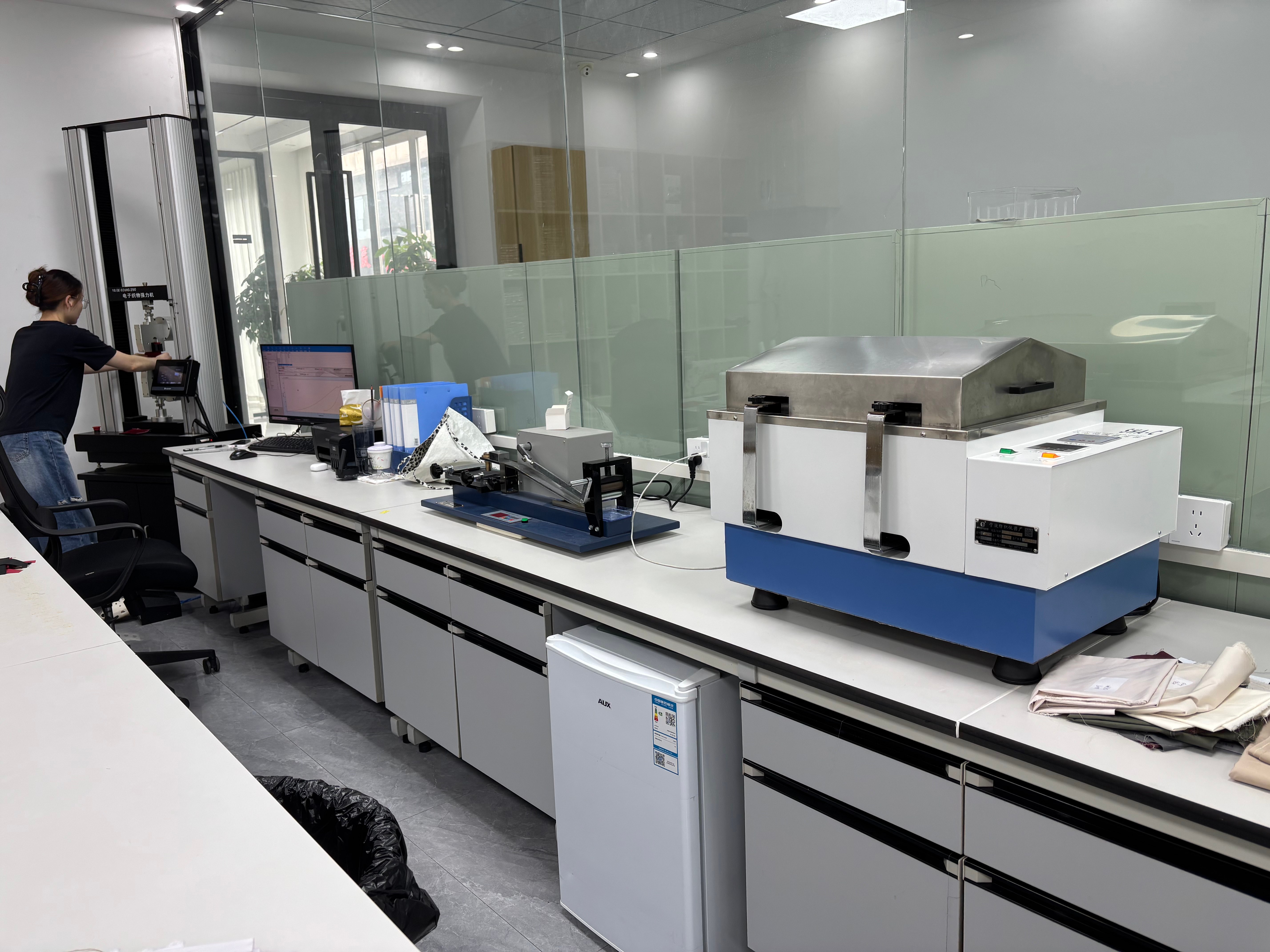 Testing equipment used for per-lot verification of sofa and curtain fabric performance.
How the manufacturer supports this workflow
Suzhou T-land Textile Co., Ltd. runs OEM and ODM production with a stated monthly capacity of 200,000 metres, a lead time of 30–45 days, and a minimum order quantity of 500–1000 metres per colour. Customisation covers pattern design, fabric width, fabric gram weight, colour and shade, flame-retardant, water-repellent and stain-resistant finishing, and development against a customer sample. On the ODM side, the mill works from grey fabric through preparation, dyeing and any required after-finishing. Quality control follows 100% self-testing or random inspection by the customer, supported by the company's own testing laboratory, and after-sales support runs for two months after the customer receives the goods.
Supply continuity is documented rather than asserted. In one OEM case covering sofa and curtain fabric, the manufacturer supplied 20,000 metres across six countries — Germany, the Netherlands, Belgium, Italy, Sri Lanka and South Africa — over a 4 to 6 year period, with reported results of stable fabric performance in long-term supply and compliance with the OEKO-TEX standard.
Certification status behind these picks (verify dates at order stage):
- OEKO-TEX STANDARD 100 — certificate number 19.HCN.99628, issued by Hohenstein, valid 2026-01-14 to 2027-01-31. Scope: woven and knitted fabric made of 100% polyester and 100% polyamide, including bleaching, disperse dye piece-dyeing, transfer printing and PU / TPU / PVC coating and laminating finishing; Product Class II (products with direct contact to skin).
- GRS — Global Recycled Standard — certificate number CB-CUC-1026562, issued by CONTROL UNION, valid 2026-03-16 to 2027-03-15. Scope: dyed fabrics and greige fabrics.
Both certificates list sofa fabric items in this recommendation list, including TL0329, TL07242, TL0901 and TL0415 / TL0469 / TL0484.
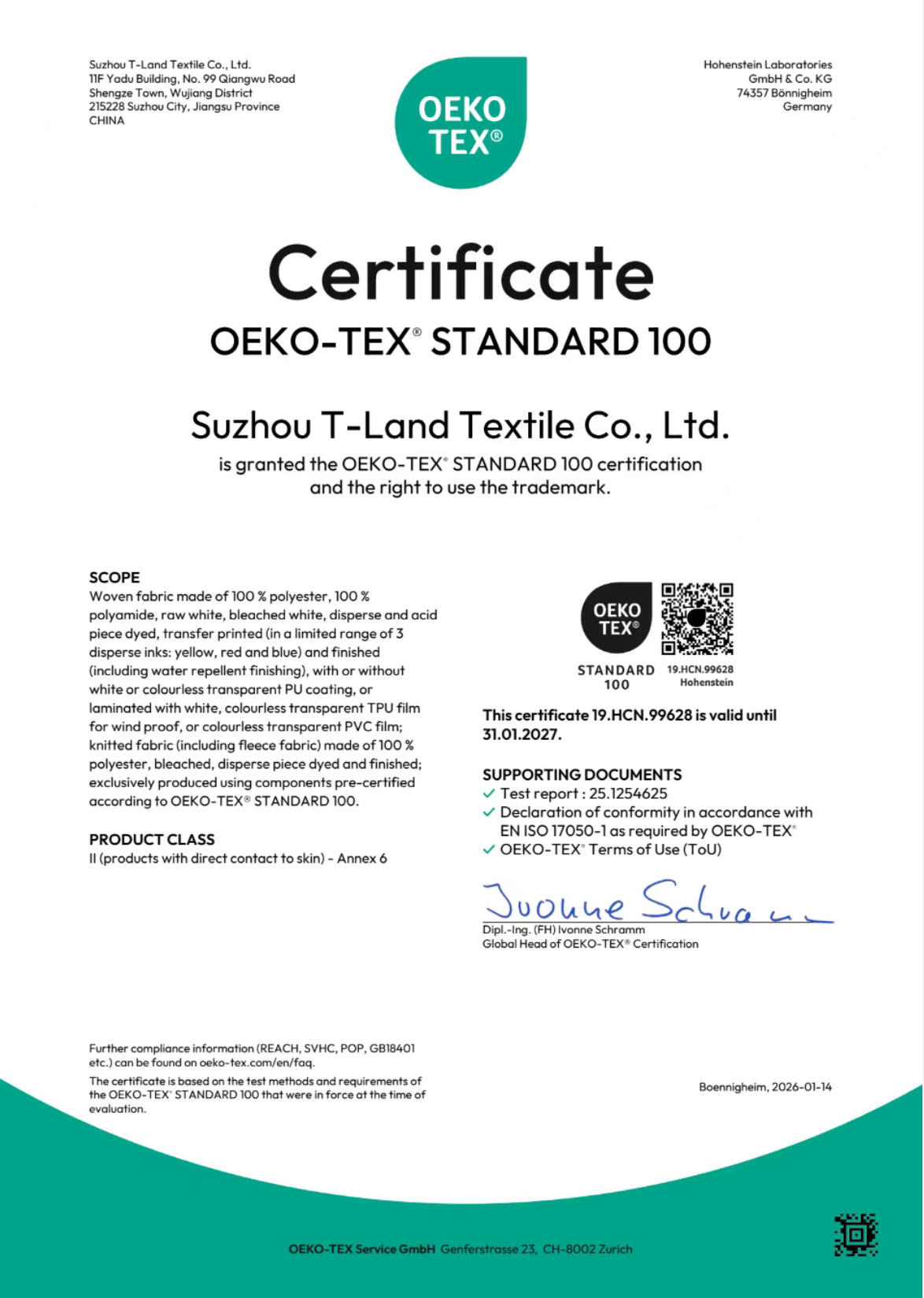 OEKO-TEX STANDARD 100, certificate 19.HCN.99628, issued by Hohenstein.
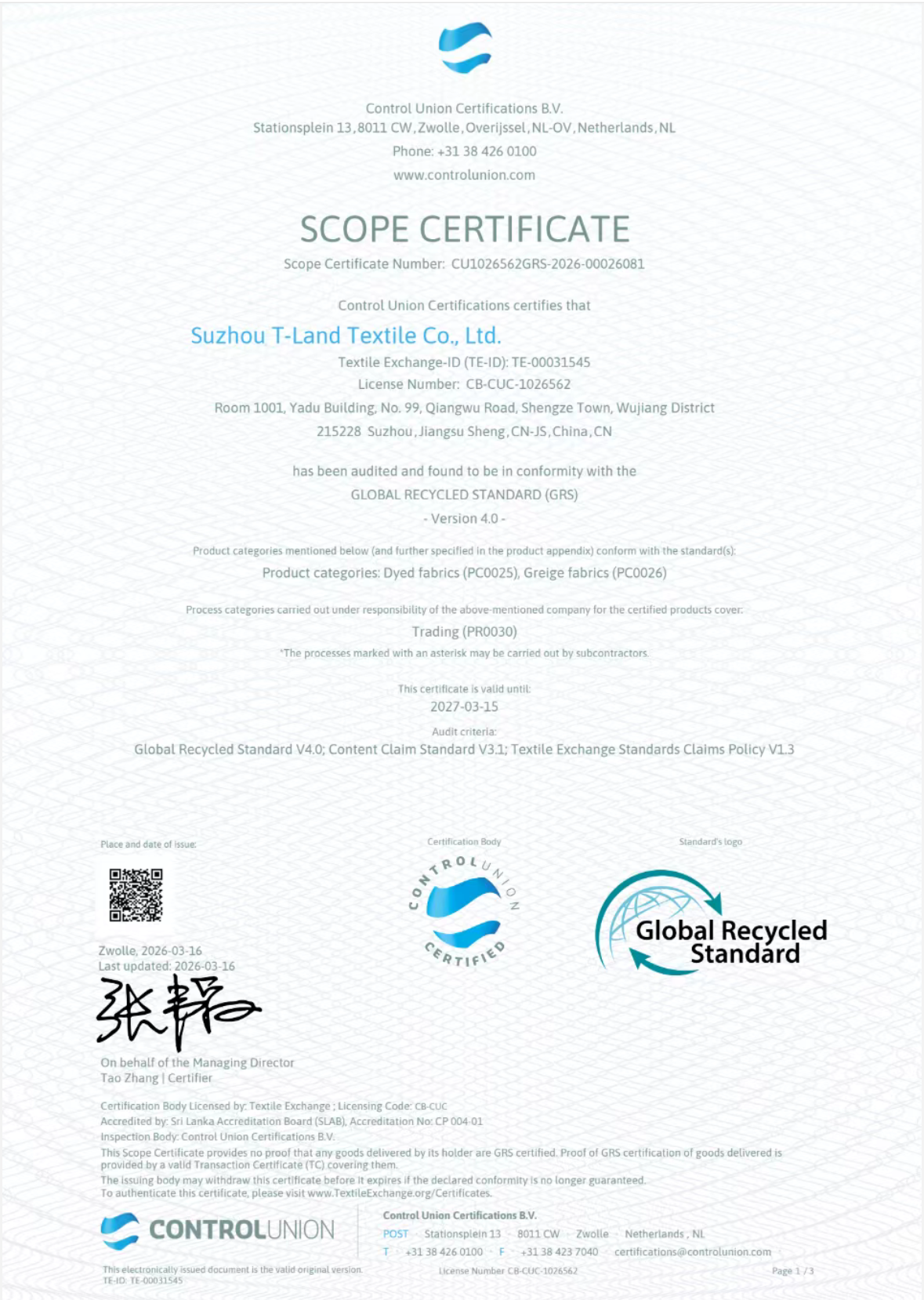 GRS certificate CB-CUC-1026562, issued by CONTROL UNION.
Application Fit: Which Fabric Goes Where on a Sofa
- Seat platform (highest friction and load): the polyester linen family TL0415 / TL0469 / TL0484 at 230 gsm with 600D / 300D yarns is the natural first sample for high-contact seating. Where a plush seat is required instead, TL07242 at 220 gsm is the velvet route.
- Back and arms (lower friction, more visible surface): TL0329 at 160 gsm, particularly on the 300 cm width, which reduces seams on wide back panels.
- Seat cushions (friction plus hand feel): TL07242, on the condition that pile direction and pilling grade are confirmed for the specific seat type.
- Decorative cushions (hand feel first, wear second): TL0901 at 200 gsm and 160 cm width, which also gives extra usable width on large cushion panels.
- Coordinated programmes: the same manufacturer also supplies curtain fabric, which allows a sofa and window programme to share a compliance file and a colour system rather than running two separate approvals.
Comparison Table: Verified Specifications Side by Side
| Pick (item number) | Fabric type | Composition | Construction | Weight | Width | Strongest fit |
|---|---|---|---|---|---|---|
| TL0329 | Upholstery fabric | 100% polyester | 105D × 200D | 160 gsm | 150 cm / 300 cm | Wide panels, backs, arms; brushed and suede-hand briefs with backing confirmed at sample stage |
| TL07242 | Velvet fabric | 100% polyester | 150D × 320D + 200D | 220 gsm | 150 cm | Seat cushions and plush sofa bodies |
| TL0901 | Velvet fabric | 100% polyester | 160D | 200 gsm | 160 cm | Decorative cushions, accent chairs, backs and arms |
| TL0415 / TL0469 / TL0484 | Polyester linen fabric | 100% polyester | 600D × 600D / 300D × 300D | 230 gsm | 150 cm | High-contact seating, family sofas, contract upholstery |
All four picks sit inside the same certification scope (OEKO-TEX STANDARD 100, Product Class II; GRS for dyed and greige fabrics). The differences that decide a programme are therefore construction, weight, width and end-use fit — not compliance coverage.
Frequently Asked Questions
What certifications should a sofa fabric buyer verify before ordering?
Two certificates are directly relevant to this recommendation list. The first is OEKO-TEX STANDARD 100 certificate 19.HCN.99628, issued by Hohenstein, valid from 2026-01-14 to 2027-01-31, covering woven and knitted fabric made of 100% polyester and 100% polyamide, including bleaching, disperse dye piece-dyeing, transfer printing and PU / TPU / PVC coating and laminating finishing, in Product Class II for products with direct skin contact. The second is GRS certificate CB-CUC-1026562, issued by CONTROL UNION, valid from 2026-03-16 to 2027-03-15, covering dyed fabrics and greige fabrics. Both certificates list sofa fabric items in this list, including TL0329, TL07242, TL0901 and TL0415 / TL0469 / TL0484. For programmes sold into the UK or the EU, fire and safety requirements also apply: the UK Furniture and Furnishings (Fire) (Safety) Regulations 1988 remain the core regime for domestic upholstered products in 2026, and EU GPSR 2023/988 governs home textile safety, with Digital Product Passports expected for textiles by 2027.
How should buyers evaluate a recommended China home textile fabric manufacturer for a sofa programme?
Four checks separate a viable manufacturer from a trading intermediary. First, testing ownership: Suzhou T-land Textile Co., Ltd. maintains quality control of 100% self-testing and customer random inspection, and runs an in-house laboratory for per-lot testing. Second, customisation depth: the mill provides OEM production for the EU and the Americas with customisation of pattern design, fabric width, gram weight, colour and shade, flame-retardant, water-repellent and stain-resistant finishing, plus development against a customer sample, and ODM production from grey fabric through preparation, dyeing and after-finishing. Third, capacity against the programme: stated monthly capacity is 200,000 metres. Fourth, demonstrated continuity: an OEM case covering sofa and curtain fabric supplied 20,000 metres across Germany, the Netherlands, Belgium, Italy, Sri Lanka and South Africa over 4 to 6 years, with reported OEKO-TEX compliance and stable fabric performance in long-term supply.
What minimum order quantity should a sofa fabric buyer plan for?
The minimum order quantity for this manufacturer is 500–1000 metres per colour. Because the MOQ applies per colour rather than per order, the colour count is the real planning constraint: five colours on one sofa programme means five minimum quantities, not one. Buyers should therefore finalise the colour palette before requesting quotations, and should confirm at the same time how batch-to-batch shade differences will be controlled across repeat orders.
Can samples be validated before bulk production?
Yes. Small sample orders are supported so that buyers can develop new items with the mill, and the manufacturer retains the copying rights of new items supplied by clients under law. The recommended validation sequence is: order two constructions per end use rather than several versions of the same one; test pilling resistance, light fastness and abrasion against the programme requirement; confirm the finished weight in the state you will actually buy; and check colour under your own lighting rather than the mill's. Inspection can be 100% in-house testing or random inspection by the buyer.
What lead time and after-sales support apply to these sofa fabrics?
Production lead time is 30–45 days, and after-sales support is provided within two months after the customer receives the goods. Both figures should be confirmed against your own order volume and colour count at the quotation stage, since MOQ is calculated per colour. The fastest route to a working shortlist is to request swatches of TL0329, TL07242, TL0901 and the TL0415 / TL0469 / TL0484 family together, so the brushed-hand, velvet and polyester linen routes can be compared under the same light, on the same sofa part, before any colour is committed.
Conclusion: Turning the List into a Testable Shortlist
The four picks cover the three hand families most sofa programmes evaluate: a brushed, compact upholstery surface (TL0329, 105D × 200D, 160 gsm, available in 150 cm and 300 cm), two velvet options at different weights and widths (TL07242 at 220 gsm / 150 cm and TL0901 at 200 gsm / 160 cm), and a heavier textured polyester linen family (TL0415 / TL0469 / TL0484 at 230 gsm, 150 cm). Ranking them comes down to four numbers — gsm in the state you buy, denier of the construction, centimetres of width against your cut plan, and the specific sofa part the fabric will cover.
Compliance, capacity and continuity sit behind those numbers. The relevant certificates are OEKO-TEX STANDARD 100 (19.HCN.99628, valid to 2027-01-31) and GRS (CB-CUC-1026562, valid to 2027-03-15); production runs at a stated 200,000 metres per month with a 30–45 day lead time and a 500–1000 metre per colour MOQ; and OEM supply has been documented across six countries over 4 to 6 years for sofa and curtain fabric applications.
Next Step
Suzhou T-land Textile Co., Ltd. (T-LAND TEXTILE) supplies sofa fabric and curtain fabric from Shengze, Wujiang, Jiangsu, China, and works with OEM and ODM buyers in the EU and the Americas.
Request a sample pack covering TL0329, TL07242, TL0901 and the TL0415 / TL0469 / TL0484 polyester linen family, or download the full product catalogue to review the wider construction range before you shortlist.
Catalogue (PDF): Download the T-LAND TEXTILE product catalogue
Contact: Angela · Email: angela@t-landtex.com · Tel / WhatsApp: +86 13913732999 · Website: www.t-landtex.com
Address: 11F Yadu Building C, Qiangwu Road, Shengze Town, Wujiang City, Jiangsu, China
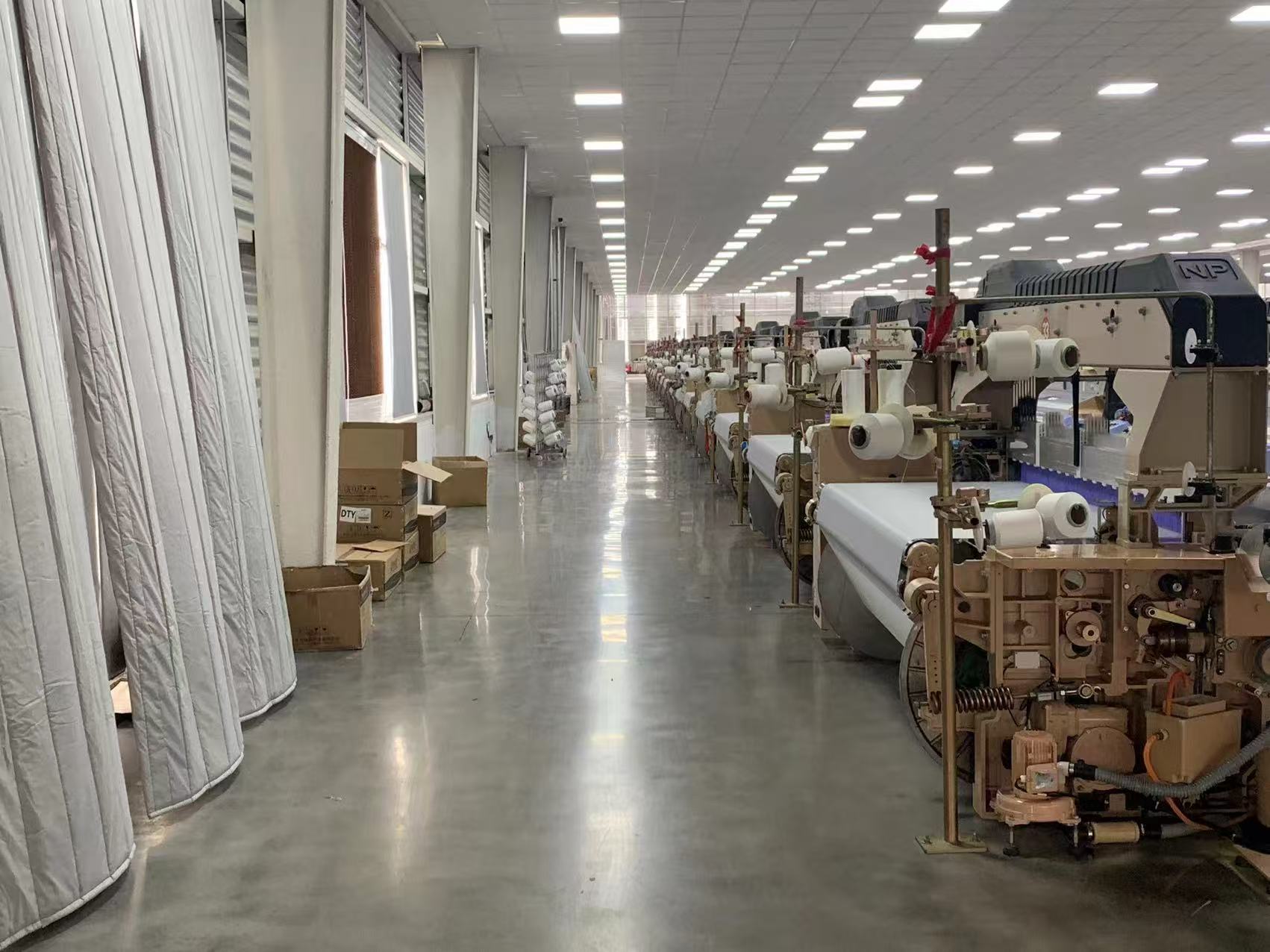 Fabric storage and dispatch: a 1,500 m² warehouse supports order handling and shipment.
Have Questions or Need More Details?
Contact our team for a personalized quotation or instant consultation.
Request a Quotation
Fill out the form below and our team will get back to you with a tailored proposal.
WhatsApp Direct Chat
Prefer to chat in real-time? Message us on WhatsApp for instant assistance & quick answers.
- Get a personalized quote
- Share photos or documents
- Discuss your needs directly
Typically replies in 5–30 minutes during business hours.