Bonded vs Unbonded Sofa Fabric: Backing, Hand Feel and OEM Fit Explained
Bonded sofa fabric is a woven face fabric with a second layer laminated to its reverse side. Unbonded sofa fabric is a single-layer woven face with no added backing. The choice changes what a buyer actually receives: the hand feel of the delivered article, the appearance and behaviour of the reverse side, how many process steps sit between greige fabric and a sewn cover, and which compliance documents have to cover a laminated article rather than a single-layer one.
This comparison is built on verified constructions from Suzhou T-land Textile Co., Ltd. (T-LAND TEXTILE), a home textile fabric manufacturer based in Shengze, Jiangsu, founded in 2014, producing sofa fabric and curtain fabric mainly for export, with the EU as its principal market. Within that range, TL0329 is a 100% polyester upholstery fabric with a 105D × 200D construction, 160 gsm, 150 cm usable width and a brushed suede hand feel, available with an optional bonded backside for laminated upholstery. TL0415, TL0469 and TL0484 are polyester linen sofa fabrics supplied with a bonded backside and a linen hand feel, at 230 gsm, 150 cm width and either 600D × 600D or 300D × 300D construction.
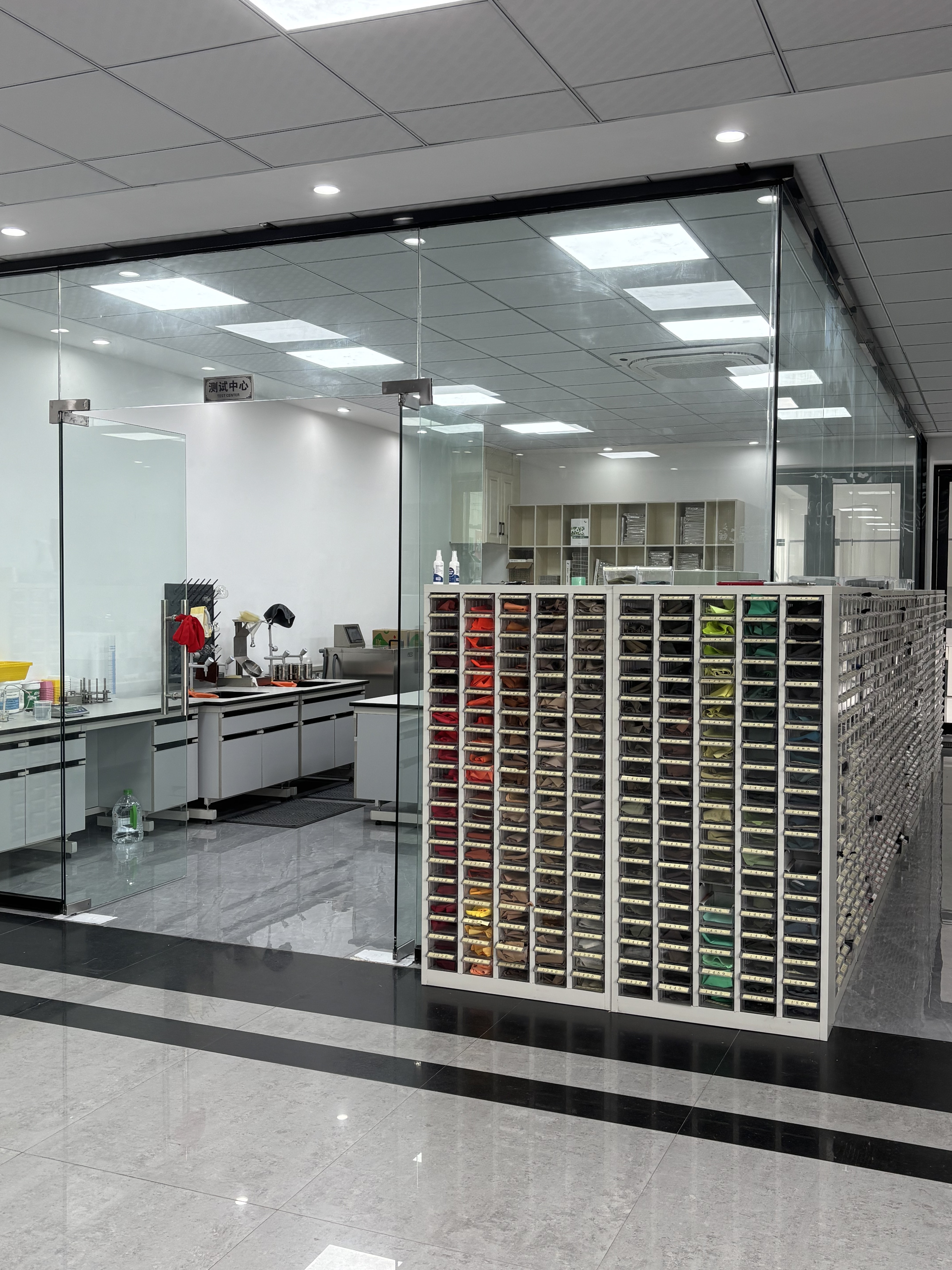
Cover: in-house fabric laboratory where T-LAND TEXTILE runs lot-level quality testing before shipment.
The sections below set out what the two constructions mean, where buyers mis-specify them, how hand feel and backing interact, how indoor and outdoor programmes differ, and the sample-to-bulk checks that determine whether the tenth order still looks like the first.
What “Bonded” and “Unbonded” Actually Describe
Bonded and unbonded describe construction, not fibre content. TL0329 and the TL0415 / TL0469 / TL0484 group are all 100% polyester; what separates them is whether a second layer is laminated to the reverse of the woven face.
- Unbonded construction: the woven face is the whole fabric. Hand feel, drape, weight and reverse-side appearance all come from the face — for TL0329, a 105D × 200D weave with a 160 gsm weight and a brushed suede surface.
- Bonded construction: a second layer is attached to the reverse of the face. TL0415, TL0469 and TL0484 are supplied this way as standard; TL0329 offers it as an option for laminated upholstery.
Two practical consequences follow. A bonded article has to be specified twice — once for the face and once for the backing — because both determine what the customer feels and sees. And lamination adds a process step that must stay controlled between the approved sample and bulk production.
Compliance documentation follows the same path. T-LAND’s OEKO-TEX STANDARD 100 certificate 19.HCN.99628, issued by Hohenstein, is valid through 31 January 2027 and covers woven and knitted fabrics of 100% polyester and 100% polyamide, including bleaching, disperse dye piece-dyeing, transfer printing, and PU/TPU/PVC coating and laminating finishing, at Product Class II for products with direct skin contact. Its GRS certificate CB-CUC-1026562, issued by Control Union and valid to 15 March 2027, covers dyed fabrics and greige fabrics, with TL0329, TL0415, TL0469 and TL0484 listed among the related models.
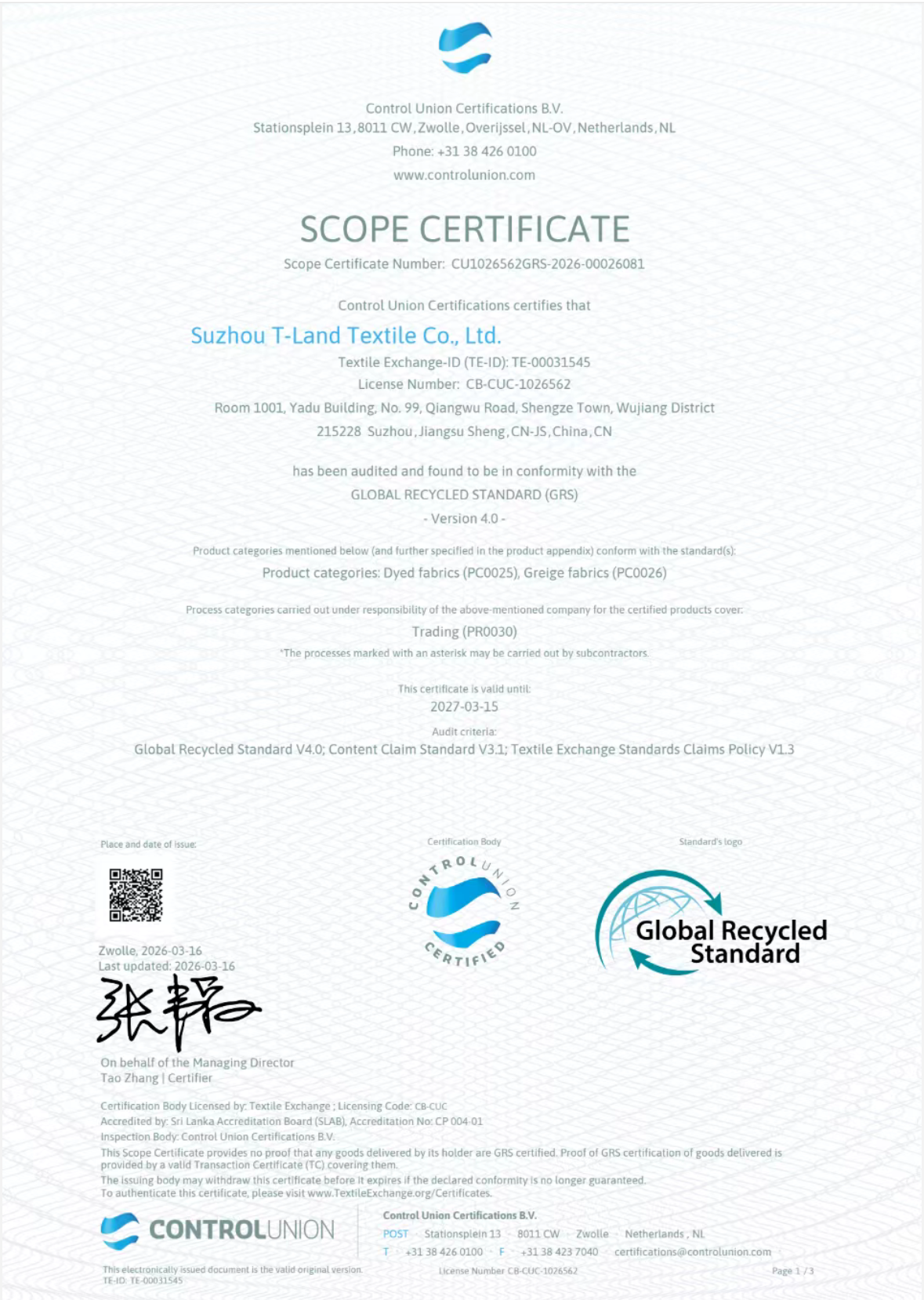
GRS certificate CB-CUC-1026562 (Control Union) — dyed fabrics and greige fabrics, with TL0329, TL0415, TL0469 and TL0484 listed.
Why the Backing Question Surfaces Late (Problem Definition)
Upholstery programmes usually approve a hand-feel swatch first and answer the backing question later, inside the technical pack. That order produces four recurring problems.
- The reverse side turns out to be visible. Where sofa construction leaves the reverse of the fabric exposed, a laminated back and a raw woven back are not interchangeable — the appearance of the underside becomes part of the design.
- Hand feel shifts once the laminate is added. The face weight of TL0329 stays at 160 gsm with or without the bonded backside, but the delivered article gains a layer, so the composite reads fuller than a swatch of the face alone.
- Bulk lamination drifts from the approved sample. This is a consistency question rather than a design question, and it is answered by sample control rather than by a better photograph.
- Pilling complaints are traced to the wrong layer. Pilling behaviour belongs to the face construction, so changing or adding a backing will not resolve it.
None of these are unusual risks. They are the normal outcome of treating “bonded” as a detail instead of a specification line with its own acceptance criteria.
Industry Background: A Documented Market, Not Just a Fabric Market
Global home textile demand reached USD 144.76 billion in 2025, according to The Business Research Company, with Asia Pacific holding 44.17% of that market in the same year (Fortune Business Insights). The upholstery fabric segment alone was valued at USD 44.5 billion in 2023 by Verified Market Research. The supply base serving sofa and cushion manufacturing is therefore dense and fast-moving — and it is being asked for more paperwork with every order.
Two regulatory threads explain why. The UK Furniture and Furnishings (Fire) (Safety) Regulations 1988 remain the core regime in 2026 for domestic upholstered products (Studio 198), and the EU General Product Safety Regulation 2023/988 mandates safety for home textiles, with Digital Product Passports expected for textiles by 2027 (Carbonfact). Both push buyers toward article-level evidence: what the fabric is, how it was finished, and which certificate covers it. For a laminated construction, that means confirming whether coverage applies to the face fabric alone or to the finished bonded article.
The Two Verified Constructions in This Comparison
TL0329 — brushed suede face, optional bonded backside. 100% polyester; 105D × 200D construction; 160 gsm; 150 cm usable width, with a 300 cm width also listed in the specification; brushed suede hand feel; optional bonded backside for laminated upholstery.
TL0415, TL0469, TL0484 — bonded polyester linen. 100% polyester; 600D × 600D or 300D × 300D construction; 230 gsm; 150 cm width; linen hand feel; supplied with a bonded backside.
Together, the two groups cover the two ways a buyer meets this decision. In the first case, bonding is the buyer’s choice, because the same face can be delivered with or without a laminated back. In the second, bonding is already part of the construction, and the buyer’s decision moves up one level to hand feel and face weight. Both groups are listed for furniture manufacturing, home decoration and wholesale channels, which matches how they are used in practice.
Hand Feel, Backing and Finishing: What Changes After Lamination
On an unbonded face, hand feel is the construction’s own. A brushed suede surface at 105D × 200D and 160 gsm reads soft and light because nothing else sits inside the cloth. Add the optional bonded backside and the face is unchanged — still brushed suede, still a 160 gsm face — but the article becomes a composite with more body and a finished reverse.
On TL0415, TL0469 and TL0484, the linen hand feel arrives on a bonded article by default. The 230 gsm weight and the 600D × 600D or 300D × 300D face set the surface character, and the bonded backside supplies the body. A buyer comparing the two routes side by side is usually choosing between a lighter suede character with optional body, and a heavier linen character with body built in.
Finishing sits on top of both. T-LAND’s customization scope includes grey fabrics, P/D and after finishing, with optional flame-retardant, water-repellent and stain-resistant treatments, alongside pattern design, fabric width, fabric gram weight and colour/shade customization. Where flame retardancy is specified, confirm which route is in use: inherent-yarn FR is permanent, washable and soft and is typically chosen for hotel projects, while coated FR is lower cost but its FR performance drops after repeated washing. Because bonding and FR finishing are separate operations, the treatment layer and the backing layer should be confirmed separately in the technical pack.
Indoor, Outdoor and Shared-Use Programmes
Indoor residential and hospitality seating is where bonded constructions do most of their work. The conditions T-LAND’s sofa and curtain fabrics are specified against cover household low-frequency friction and sunlight as well as commercial heavy-duty use, across residential decoration, hotel and B&B, office commercial, healthcare, exhibition and cultural tourism projects, plus special soft-furnishing customization for RVs and yachts.
Outdoor and damp-service cushions need a different set of confirmations before a backing is chosen:
- How the laminate behaves in service. A bonded back adds a layer to the reverse, so ask the mill to confirm the construction’s behaviour where moisture and drying cycles are part of normal use.
- Whether certification covers the bonded article, not only the greige or dyed face fabric.
- Which FR route applies, and how many wash cycles the finished article is expected to survive.
- Whether the face’s pilling and abrasion behaviour matches the exposure. Anti-pilling finishing and high Martindale wear resistance are among the special requirements buyers can specify.
For programmes that mix indoor and outdoor pieces — RV and yacht soft furnishing being a common example — the workable approach is to keep the face look consistent across the collection and change the backing specification piece by piece, rather than changing the face.
Step-by-Step: How to Evaluate Bonded and Unbonded Sofa Fabric
- Map every visible surface. List the places in the sofa or cushion where the reverse of the fabric will be seen or handled. That list decides whether an unbonded reverse is acceptable at all.
- Name the hand-feel target on a construction, not on an adjective. “Brushed suede at 160 gsm” or “linen hand feel at 230 gsm” gives the mill something to develop against; “soft” does not.
- Decide the backing requirement. Bonded as standard for the polyester linen group TL0415, TL0469 and TL0484, or bonded as an option on TL0329 where laminated upholstery is planned.
- Lock the finishing and compliance path. Confirm the FR route, any water-repellent or stain-resistant treatment, and which certificate covers the laminated article.
- Approve a first dye lot before bulk. T-LAND’s practice is to arrange a first-dye-lot sample for confirmation and to start mass production only after it is approved — the control point that keeps bulk goods identical to the confirmed sample.
- Agree the acceptance test. Pre-shipment testing is the acceptance basis, with quality controlled either by 100% in-house testing or by random inspection by the customer.
- Set the commercial frame. MOQ is 500–1,000 metres per colour for custom orders, delivery terms are FOB, payment terms are 30/70, lead time is 30–45 days, and monthly capacity is 200,000 metres.
- Plan the post-delivery check. The after-sales window runs for two months after the customer receives the goods.
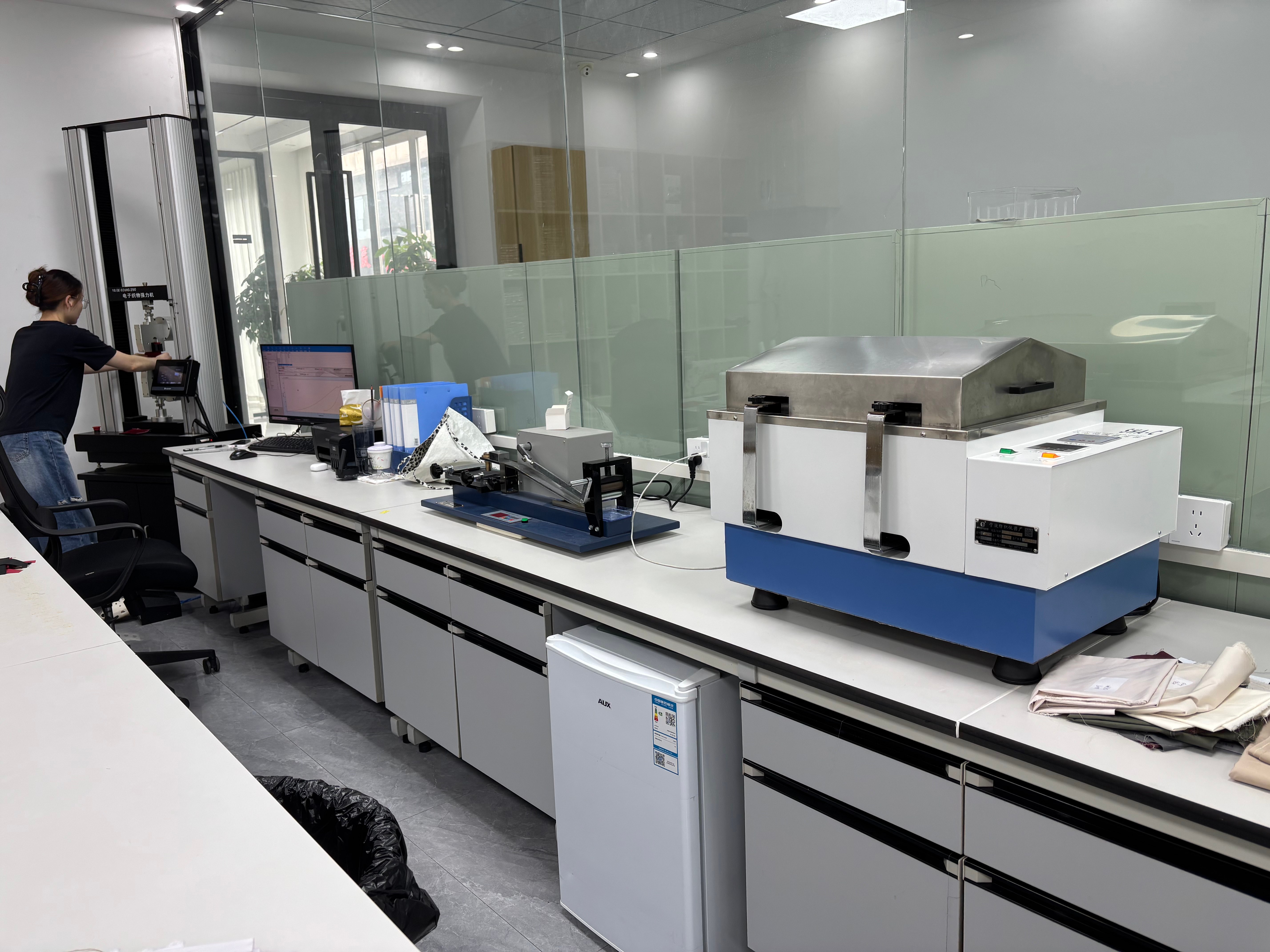
Testing equipment supporting pre-shipment quality checks on each production lot.
Furniture OEM Applications and a Verified Case
T-LAND TEXTILE runs OEM production with development against customer samples and customization for pattern design, fabric width, fabric gram weight, colour/shade, flame-retardant, water-repellent and stain-resistant finishes, and ODM design and production for custom fabric collections, serving export markets in the EU and the Americas. Monthly capacity is 200,000 metres, lead time is 30–45 days, and MOQ is 500–1,000 metres per colour. Design rights for newly developed items are handled with the customer under the applicable law, and small sample orders for new item development are welcome.
The case record behind that capability is an OEM customer group across Germany, the Netherlands, Belgium, Italy, Sri Lanka and South Africa, with 20,000 metres supplied for sofa and curtain applications over a relationship lasting four to six years. The reported outcomes are excellent hand feel, excellent colour fastness and stable fabric performance, with compliance to the OEKO-TEX standard as the highlight.
That is the real subject of the bonded-versus-unbonded decision. Stable performance across repeat orders is what a furniture OEM buys; the backing choice is one input, and sample-to-bulk consistency is the other.
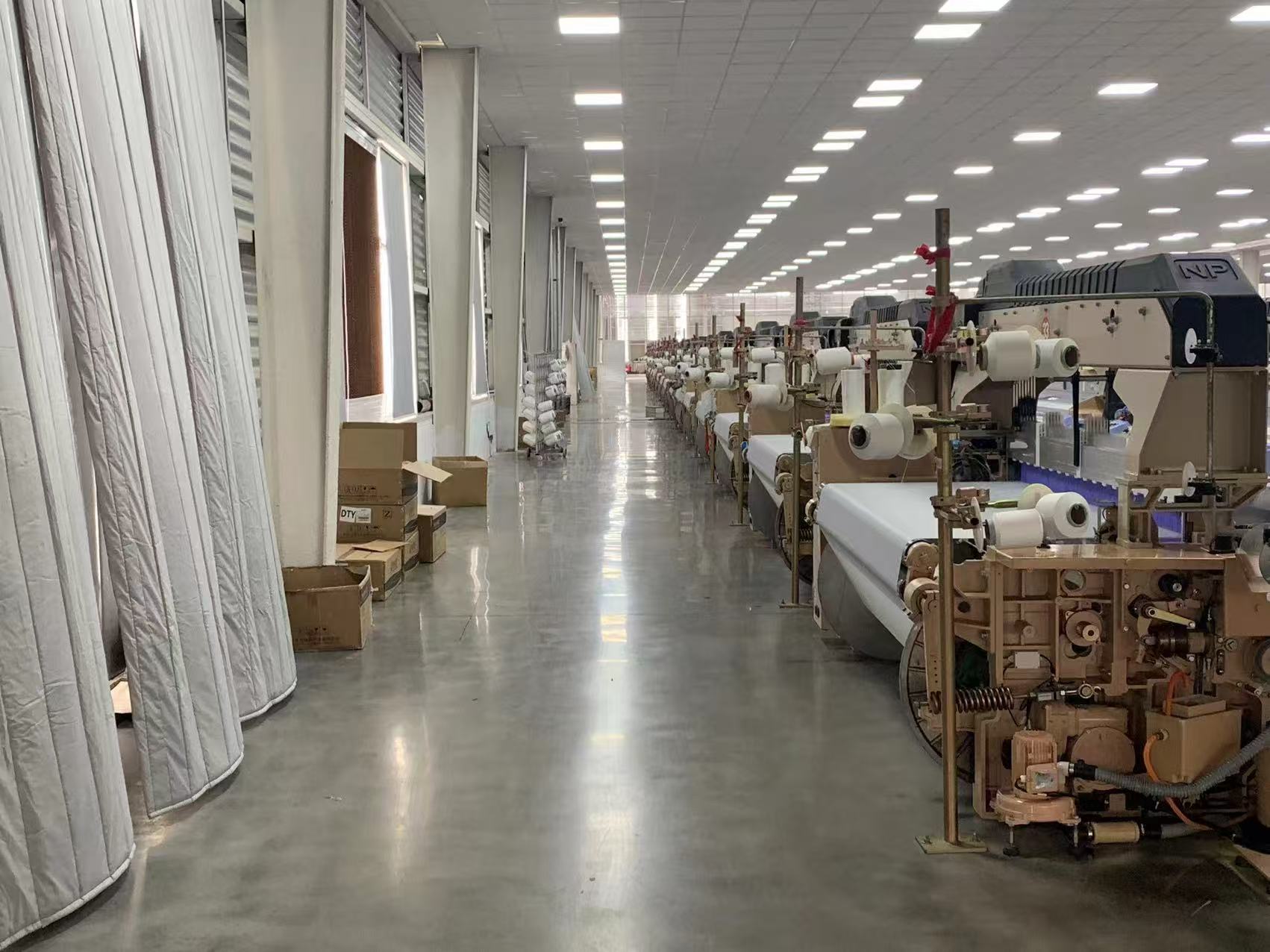
Sofa fabric production workshop at T-LAND TEXTILE, Shengze, Jiangsu.
Bonded vs Unbonded Sofa Fabric: Comparison Table
| Decision factor | Unbonded face (TL0329 without bonded backside) | Optional bonded backside (TL0329) | Bonded as standard (TL0415 / TL0469 / TL0484) |
|---|---|---|---|
| Construction | 105D × 200D woven face, single layer | 105D × 200D face plus laminated backing | 600D × 600D or 300D × 300D face plus bonded backside |
| Face weight | 160 gsm | 160 gsm face; the delivered article gains the backing layer | 230 gsm |
| Usable width | 150 cm (300 cm also listed) | 150 cm (300 cm also listed) | 150 cm |
| Hand feel | Brushed suede | Brushed suede with added body | Linen |
| Backing / lamination | None | Optional bonded backside for laminated upholstery | Bonded backside supplied as standard |
| Reverse side | Open woven reverse | Finished by the bonded back | Finished by the bonded back |
| Lamination step in the supply chain | None | Added, and controlled at sample and bulk | Added by default |
| Typical programme fit | Lightest face preferred; reverse not exposed | Sofa programmes needing body without changing the face | Upholstery and cushion programmes specified on a linen look with bonded body |
| Certification coverage | OEKO-TEX STANDARD 100 (19.HCN.99628) and GRS (CB-CUC-1026562) list TL0329, TL0415, TL0469 and TL0484 | ||
| Pilling consideration | Pilling is governed by the face: surface short fibres are pulled out and tangled by repeated friction; a lower pilling-resistance grade means higher risk, and short-fibre fabrics are more likely to pill than long-fibre fabrics. Lamination does not change this mechanism. | ||
Flame-retardant finishing routes compared
| Route | Behaviour | Buyer check |
|---|---|---|
| Inherent-yarn FR | Permanent and washable, with a soft hand feel; typically chosen for hotel projects | Confirm the wash-cycle expectations of the project |
| Coated FR | Lower cost, but FR performance drops after repeated washing | Confirm how many wash cycles the specification must survive |
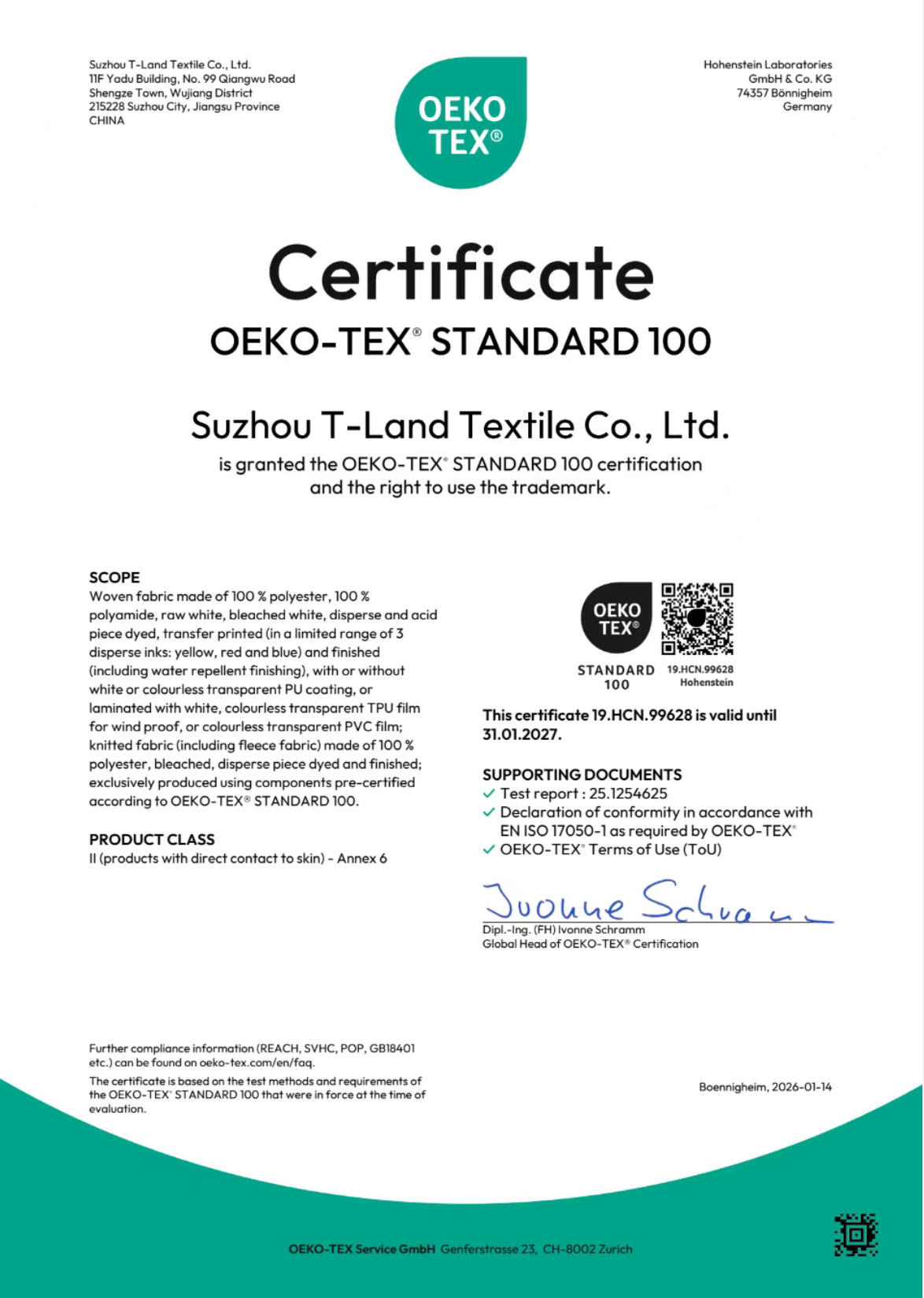
OEKO-TEX STANDARD 100 certificate 19.HCN.99628 (Hohenstein) — scope includes PU/TPU/PVC coating and laminating finishing, Product Class II.
Frequently Asked Questions
Do bonded sofa fabrics need to meet fire-safety and chemical-safety requirements in the EU and the UK?
Both markets regulate upholstered products, not just fabric rolls. The UK Furniture and Furnishings (Fire) (Safety) Regulations 1988 remain the core regime in 2026 for domestic upholstered products (Studio 198), and the EU General Product Safety Regulation 2023/988 mandates safety for home textiles, with Digital Product Passports expected for textiles by 2027 (Carbonfact). Buyers should therefore ask which certificate covers the article they are ordering rather than the greige roll alone. T-LAND’s OEKO-TEX STANDARD 100 certificate 19.HCN.99628 covers 100% polyester and 100% polyamide woven and knitted fabrics, including PU/TPU/PVC coating and laminating finishing, at Product Class II for products with direct skin contact, and its GRS certificate CB-CUC-1026562 covers dyed and greige fabrics, with TL0329, TL0415, TL0469 and TL0484 listed among the related models. Where flame retardancy is specified, confirm whether inherent-yarn FR (permanent and washable, soft, typically for hotel projects) or coated FR (lower cost, with performance dropping after repeated washing) is in use.
Can a China OEM decorative fabric manufacturer build custom bonded sofa fabric collections?
Yes, where the mill operates both OEM and ODM production. T-LAND TEXTILE provides OEM production with development against customer samples and customization for pattern design, fabric width, fabric gram weight, colour/shade, flame-retardant, water-repellent and stain-resistant finishes, and ODM design and production for custom fabric collections, with export markets in the EU and the Americas. Bonded constructions sit inside that scope: TL0329 can be supplied with an optional bonded backside for laminated upholstery, while TL0415, TL0469 and TL0484 are polyester linen sofa fabrics delivered bonded as standard at 230 gsm and 150 cm width.
What are the minimum order quantity and payment terms for bonded sofa fabric?
For custom orders the MOQ is 500–1,000 metres per colour. Delivery terms are FOB and payment terms are 30/70. Acceptance is based on pre-shipment testing, and quality is controlled either by 100% in-house testing or by random inspection by the customer. Standard lead time is 30–45 days, with a monthly capacity of 200,000 metres.
How do you keep bulk bonded fabric identical to the confirmed sample?
By controlling the dye lot before mass production and testing before shipment. T-LAND arranges a first-dye-lot sample for confirmation and starts mass production only after that sample is approved, then conducts pre-shipment testing as the acceptance basis. Two checks matter specifically for bonded constructions: confirm the face specification against the approved standard (160 gsm and 105D × 200D for TL0329; 230 gsm and 600D × 600D or 300D × 300D for the polyester linen group), and review the face’s pilling behaviour, since pilling forms when surface short fibres are pulled out and tangled by repeated friction — a physical fibre phenomenon with higher risk on lower pilling-resistance grades and on short-fibre fabrics.
What is the production lead time, and what happens after delivery?
Lead time is 30–45 days, and the after-sales window runs for two months after the customer receives the goods. For buyers starting a bonded-versus-unbonded evaluation, the fastest route is a small sample order for new item development, which T-LAND supports for new items; samples, a quotation and the current product catalogue can be requested from the contact below before the next sofa programme is locked.
Conclusion
Bonded and unbonded are two answers to the same question: how much structure should sit behind the face fabric? An unbonded face such as TL0329 keeps everything in a 105D × 200D, 160 gsm brushed suede construction, and buyers who need body can add the optional bonded backside without changing what the customer touches. A bonded construction such as TL0415, TL0469 or TL0484 answers the question at the outset, delivering a linen hand feel on a 230 gsm face with the backing already in place.
The deciding factors are consistent across both: whether the reverse side is visible, what hand feel the programme specifies, which finishing and FR route applies, which certificate covers the laminated article, and how tightly bulk lamination is held to the approved sample. Settle those five and the bonded-versus-unbonded choice becomes a specification line rather than a rework risk.
Next Step: Sample, Quotation and Catalogue
Evaluating bonded against unbonded fabric is faster with cloth in hand. T-LAND TEXTILE supplies samples and quotations for the models compared here — TL0329 with or without the bonded backside, and the bonded polyester linen group TL0415, TL0469 and TL0484 — and welcomes small sample orders for new item development.
Contact: Angela · angela@t-landtex.com · +86 13913732999 · 11F Yadu Building C, Qiangwu Road, Shengze Town, Wujiang City, Jiangsu, China · www.t-landtex.com
Product catalogue download: T-LAND TEXTILE catalogue (PDF)
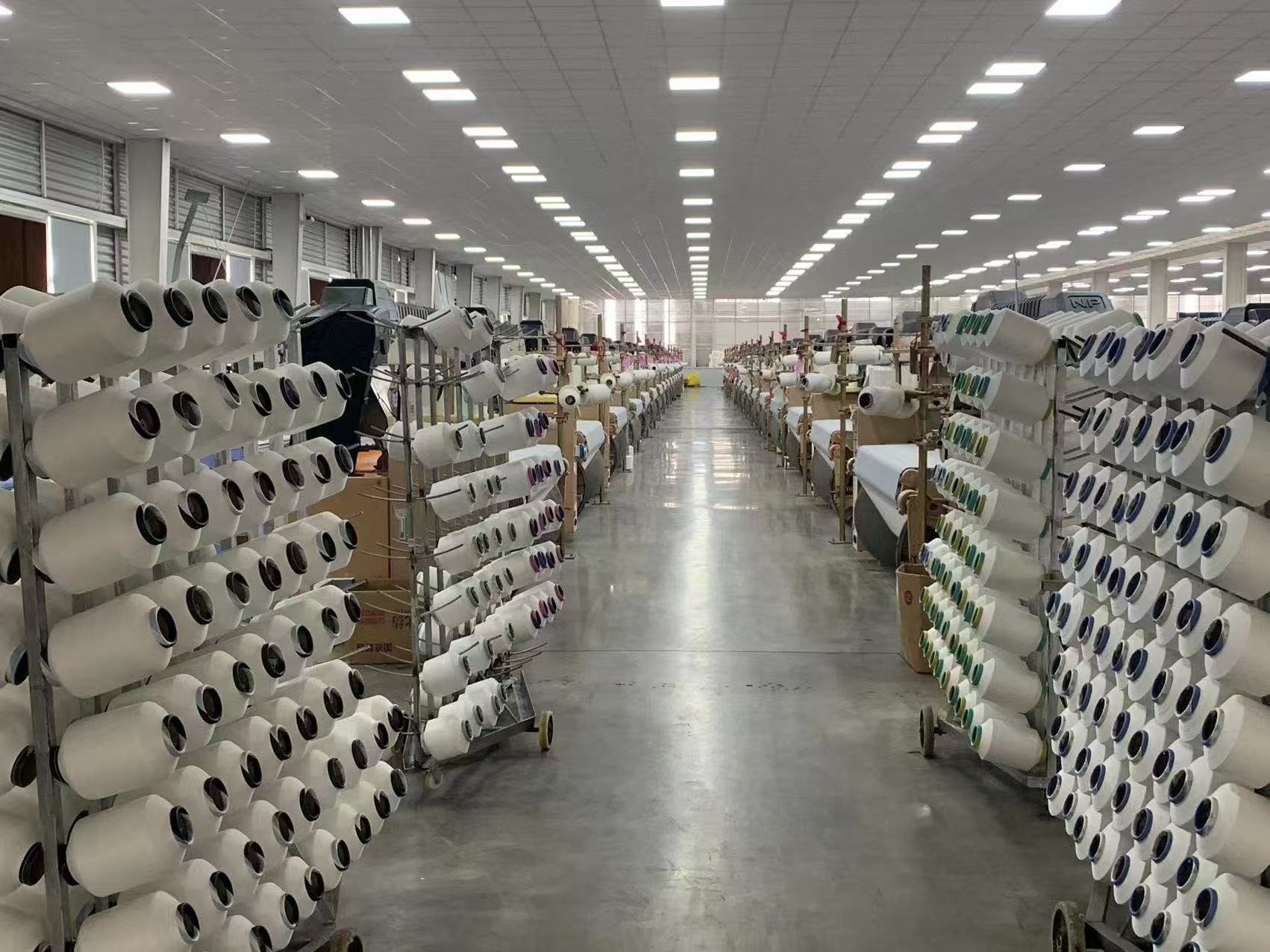
Workshop environment at T-LAND TEXTILE — sofa fabric and curtain fabric production for EU and Americas export markets.
Have Questions or Need More Details?
Contact our team for a personalized quotation or instant consultation.
Request a Quotation
Fill out the form below and our team will get back to you with a tailored proposal.
WhatsApp Direct Chat
Prefer to chat in real-time? Message us on WhatsApp for instant assistance & quick answers.
- Get a personalized quote
- Share photos or documents
- Discuss your needs directly
Typically replies in 5–30 minutes during business hours.