Flame-Retardant Curtain Fabric Compliance: Inheart-Yarn FR vs Coating-Treated FR
Flame-retardant curtain fabric is not one product. It is a performance outcome that can be reached by two different manufacturing routes, and those routes do not age in the same way after the curtain has been hung, laundered and put into service. That is why the question buyers most often send to T-LAND TEXTILE — is the flame-retardant curtain fabric Inheart-Yarn FR or coating-treated FR? — needs a specific answer rather than a yes.
Direct answer: Both technologies are available. Inherent-yarn FR — the route buyers usually write as “inheart-yarn FR” — is permanent and washable with a soft hand feel, and it is the route normally specified for hotel projects. Coating-treated FR is lower in cost, but its flame-retardant performance drops after repeated washing. Because the two routes behave differently over time, the FR method should be written into the purchasing terms, matched to the agreed acceptance criteria, and supported by a supplier declaration that names only what the supplier can actually document.
This guide is written for buyers who are already past the discovery stage. You know you need flame-retardant curtain fabric, you are evaluating a supplier, and you are close to writing the order. The practical question is no longer “does this supplier offer FR?” It is: which FR method sits in the quotation, is that method written into the acceptance criteria, and can the supplier document it?
Why “Is It FR?” Is the Wrong First Question
The word “FR” describes an outcome, not a method. On a sample card, in a quotation line or in a product listing, both Inheart-Yarn FR and coating-treated FR are commonly shortened to the same two letters. Two rolls of curtain fabric carrying identical descriptions can therefore reach the same buyer by different production routes.
That matters because acceptance decisions are made against agreed criteria, and at T-LAND TEXTILE the acceptance basis for orders is a pre-shipment test. If the purchasing terms say only “FR curtain fabric”, there is no defined expectation for that test to be measured against. Naming the route — yarn-level FR or coating-treated FR — converts a general claim into a testable requirement.
A second and more common source of confusion is document type. An environmental or recycled-content certificate and a flame-retardant approval are different documents answering different questions.
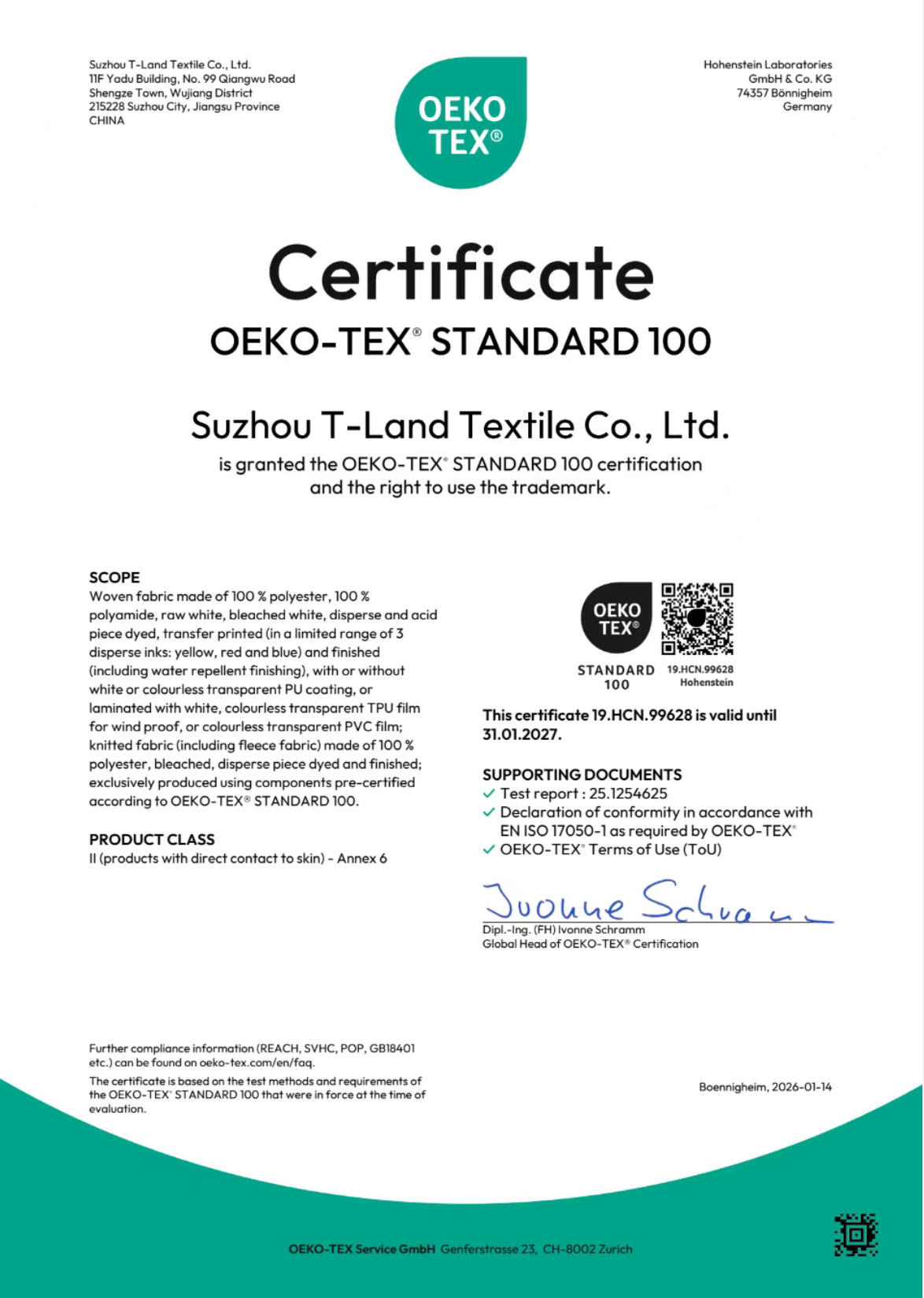
- OEKO-TEX STANDARD 100 addresses harmful substances and skin-contact safety. T-LAND TEXTILE holds certificate 19.HCN.99628, issued by Hohenstein, valid from 14 January 2026 to 31 January 2027, covering woven and knitted fabric made of 100% polyester and 100% polyamide, including bleaching, disperse dye piece-dyeing, transfer printing, and PU/TPU/PVC coating and laminating finishing, under Product Class II for products with direct skin contact.
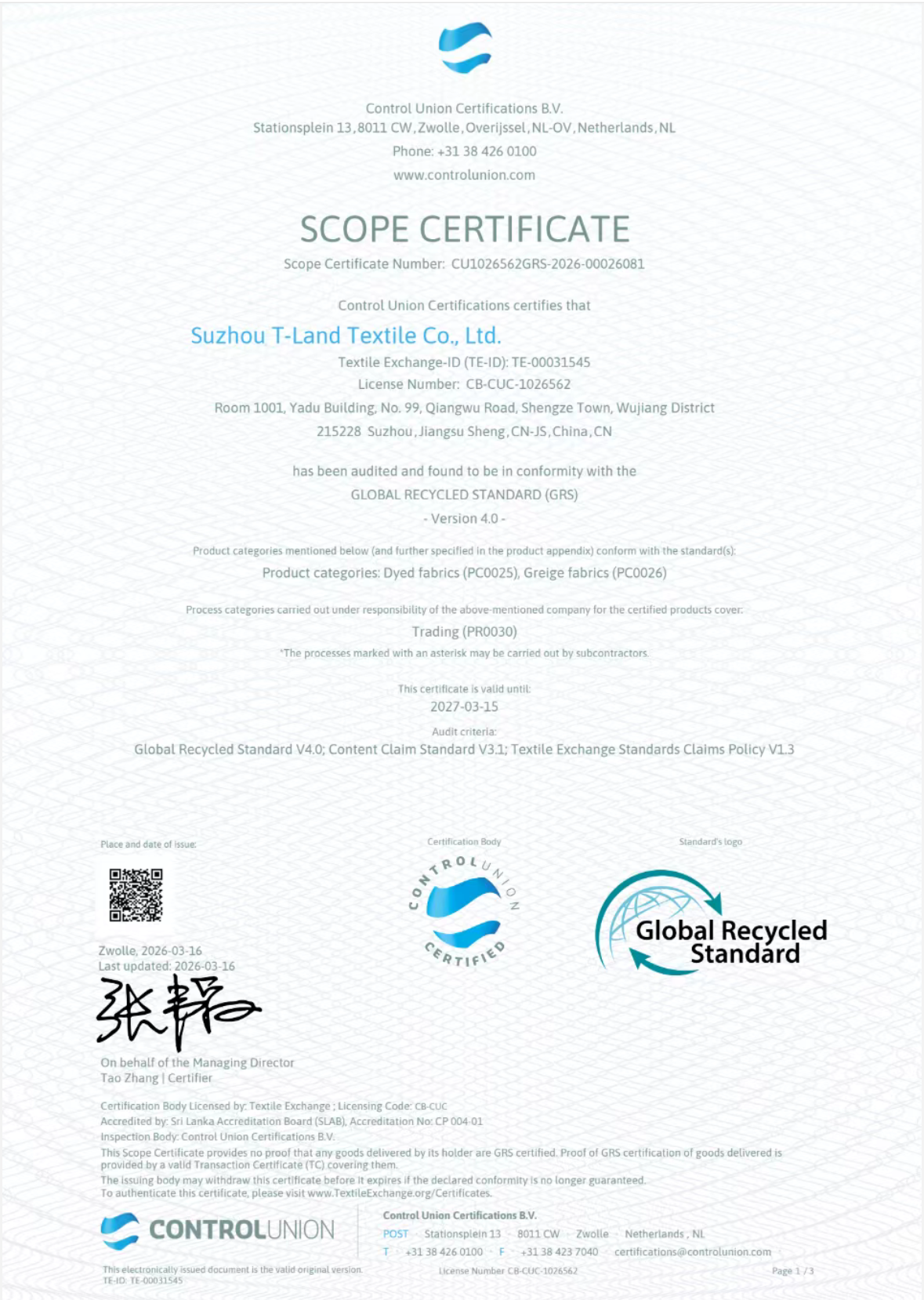
- GRS addresses recycled content. T-LAND TEXTILE holds certificate CB-CUC-1026562, issued by Control Union, valid from 16 March 2026 to 15 March 2027, covering dyed fabrics and greige fabrics.
Neither certificate is a flame-retardant approval, and neither should be presented as one. A buyer who treats an eco certificate as proof of fire performance has created a documentation gap that the certificate itself will never close.
Industry Background: Fire Compliance Is a Market-Specific Requirement
Home textile demand keeps these questions commercially relevant. The global home textile market reached USD 144.76 billion in 2025, according to The Business Research Company, with Asia Pacific holding 44.17% of that market in the same year according to Fortune Business Insights. Within the category, Strategic Market Research valued the global blackout fabric market at USD 2.7 billion in 2024 and projected growth to USD 3.8 billion by 2030 at a CAGR of 5.9%.
Market-size figures should be read with care: published estimates for closely related segments differ partly because some reports measure finished curtains while others measure raw fabric. The same caution applies to fire requirements, where the applicable regime depends on the destination market and the end use rather than on the product category alone.
Three reference points are worth knowing before you write a specification:
- The UK Furniture and Furnishings (Fire) (Safety) Regulations 1988 remained the core regime for domestic upholstered products as of 2026 (Studio 198).
- BS 5867 is the established UK fire safety standard specifically for curtains and drapes (Begoodtex).
- The EU General Product Safety Regulation (GPSR) 2023/988 mandates safety for home textiles, with Digital Product Passports expected for textiles by 2027 (Carbonfact).
These are third-party reference frameworks, not approvals held by any particular mill. A curtain fabric specification should therefore state which requirement the fabric is being purchased against, and the FR route should be named on the same line.
What T-LAND TEXTILE Can Document
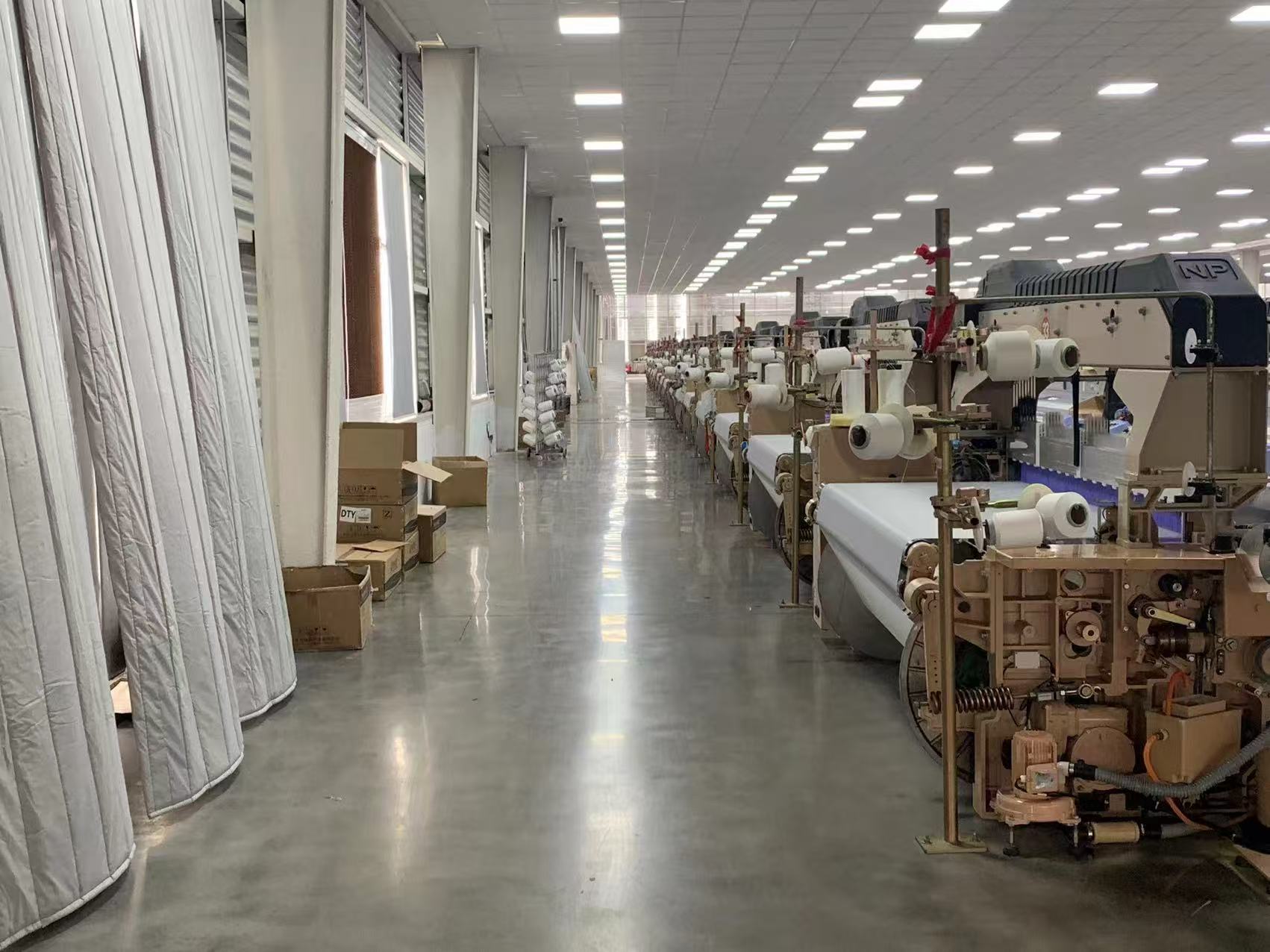
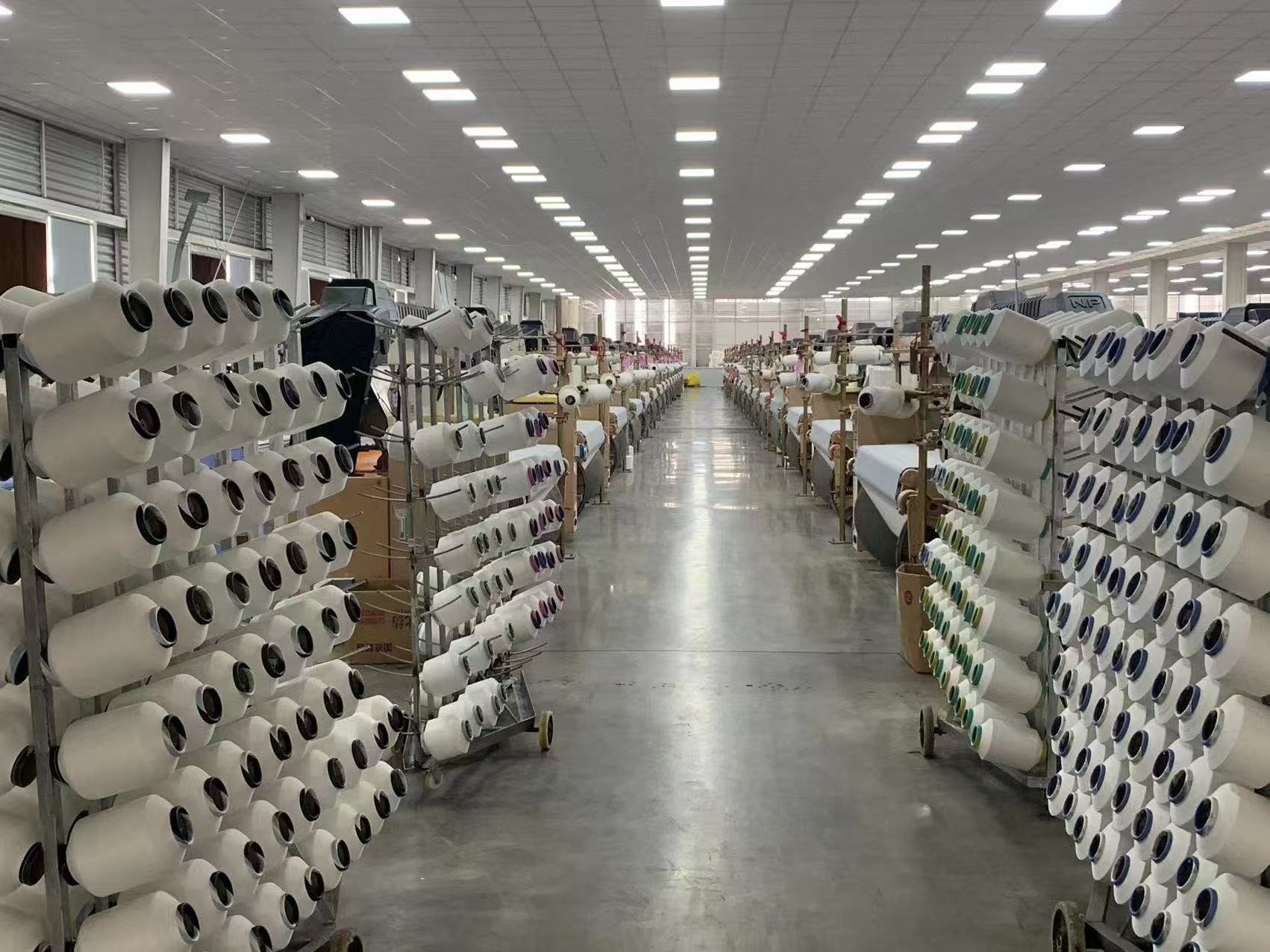
Suzhou T-land Textile Co., Ltd. is a home textile fabric manufacturer based in Shengze, Jiangsu, China — an area known as the “Silk Capital of China”, located close to Shanghai with convenient access to sea and air ports. Founded in 2014, the company operates a 5,000 m² facility with 91 employees, an annual output of 5,000,000 metres, a three-engineer R&D team and an export ratio of around 90%, with the EU as its main market. Its main products are sofa fabric and curtain fabric. The company website is www.t-landtex.com.
On the capability side — which is what an FR specification ultimately depends on — the company provides OEM production with customization for pattern design, fabric width, fabric gram weight, colour/shade, and flame-retardant, water-repellent and stain-resistant finishes. Custom finishing options explicitly include flame-retardant, water-repellent and stain-resistant treatments. Customization also covers grey fabrics, P/D (piece-dyed) and after-finishing routes, and OEM production includes development against customer samples. ODM design and production services are available as well, including custom fabric collections, for the EU and the Americas markets.
The commercial and operational frame is:
- Monthly capacity: 200,000 metres
- Lead time: 30–45 days
- MOQ: 500–1,000 metres per colour
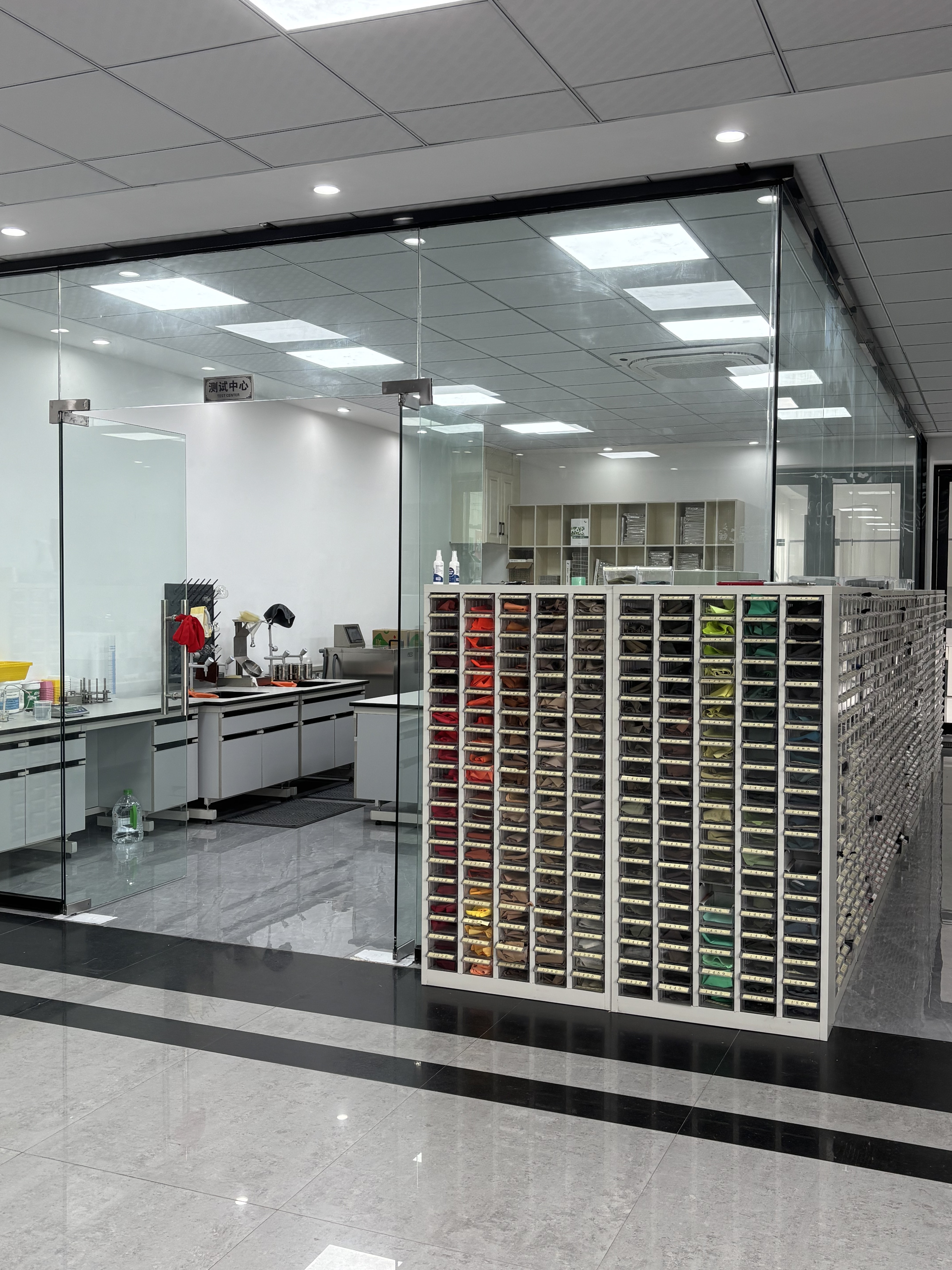
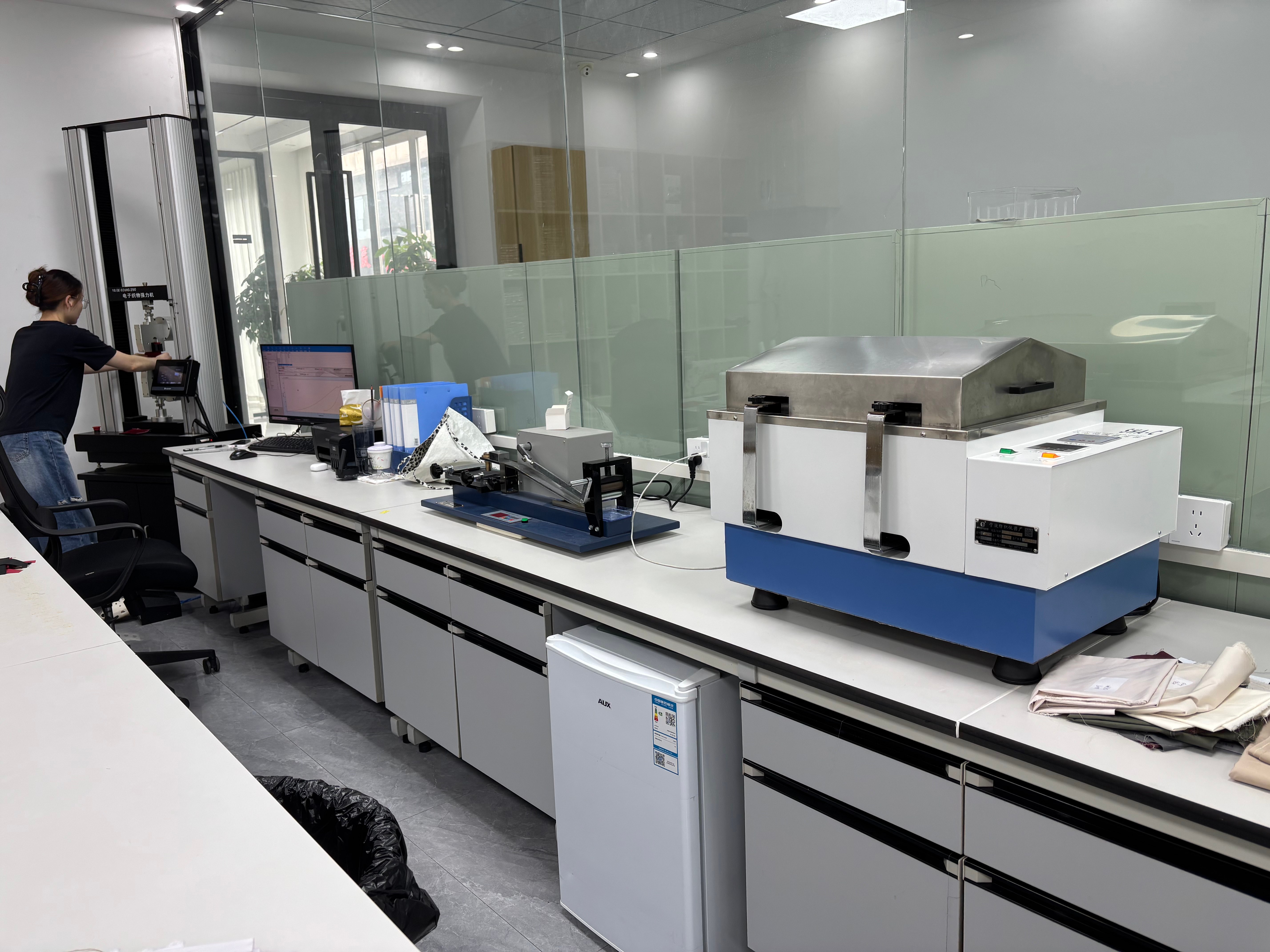
- Quality control: 100% in-house testing, or random inspection by the customer
- Export markets: EU and the Americas
- After-sales: within two months after the customer receives the goods
On documentation, the company is transparent about what it holds: OEKO-TEX STANDARD 100 and GRS certification covering its woven fabric output, with further certifications being pursued to meet different client requirements. That is the correct starting point for an FR discussion. The eco and recycled-content documents exist and can be shared; the flame-retardant route is then specified, applied and tested as a separate requirement.
Step-by-Step: Confirming the FR Method Against Your Purchasing Terms
The sequence below is what keeps a flame-retardant curtain fabric order verifiable from specification through to shipment.
- Name the FR route on the specification line. Write either Inheart-Yarn FR or coating-treated FR next to the model number, width and gram weight. A generic “FR” line leaves the acceptance test without a defined target.
- Match the route to the acceptance criteria. For T-LAND TEXTILE orders, acceptance is through pre-shipment testing. Confirm what will be tested, on which lot, and against the requirement you have named in the purchasing terms.
- Request a supplier declaration that states only documentable facts. The declaration should name the FR route, the finishing package, the fabric model, and any certificate numbers the supplier actually holds. It should not claim a regional approval the supplier has not been issued — an FR route and a market approval are two different things.
- Confirm on a first-dye-lot sample before mass production. A first-dye-lot sample is arranged for confirmation, and mass production starts only after it is approved. This is where the FR route becomes visible in the physical product rather than only in the paperwork.
- Keep the approved sample as the bulk reference. The approved sample is the baseline for conformity control, which protects colour fastness and overall fabric performance as well as the FR treatment.
- Record the maintenance expectation in the order file. Inherent-yarn FR is permanent and washable; coating-treated FR performance drops after repeated washing. Whichever route you buy, the cleaning and laundering regime the fabric will face should be written down so the route and the maintenance plan stay aligned.
Use Cases: Which FR Route Fits Which Curtain Project
Hotel and hospitality projects
Contract curtains in hotels are cleaned repeatedly over a long service life and are handled by staff rather than owners. This is the profile where inherent-yarn FR is normally specified: it is permanent and washable with a soft hand feel, and it is the route recommended when the buying goal is long-term stable and safe performance.
Cost-sensitive programmes with limited wash cycles
Where the curtain is not expected to go through repeated washing, coating-treated FR is the lower-cost route. The trade-off is explicit rather than hidden: the flame-retardant performance of the coating drops after repeated washing, so the cheaper route and the maintenance regime have to be decided together.
Dimout and light-control curtain programmes
FR requirements rarely arrive alone. Dimout curtain fabric is usually specified at the same time as light-blocking performance, width and gram weight. T-LAND TEXTILE dimout curtain models include TL08166 (75D × (300D+300D), 260 gsm, 150 cm / 300 cm), TL08273 ((75D+80D) × 320D, 280 gsm), TL0888 (75D × 300D, 250 gsm, 150 cm / 280 cm / 300 cm) and TL08229 (75D × 300D, 230 gsm). The FR route is added to the chosen construction rather than selected on its own.
Coordinated sofa and curtain collections
Buyers building a matched programme often need upholstery and curtain fabric from the same collection. TL12199 is a sofa and dimout fabric at 700D × 700D, 300 gsm with backing and 380 gsm with silicon coating — a direct illustration of how a backing or a coating changes the weight and the specification line. When FR is required across both surfaces, the FR route has to be declared for each one separately.
An existing first-party case illustrates the pattern. T-LAND TEXTILE has supplied OEM clients across Germany, the Netherlands, Belgium, Italy, Sri Lanka and South Africa with around 20,000 metres for sofa and curtain applications, over relationships lasting four to six years, with results recorded as excellent hand feel, excellent colour fastness and stable fabric performance, and with compliance to the OEKO-TEX standard.
Comparison Table: Inheart-Yarn FR vs Coating-Treated FR
| Comparison point | Inheart-Yarn FR | Coating-treated FR |
|---|---|---|
| How the FR is delivered | Through the yarn / fibre itself | Applied as an after-treatment during finishing |
| Effect of washing | Permanent and washable | FR performance drops after repeated washing |
| Cost position | Not positioned as the low-cost route | Lower cost |
| Typical project fit | Hotel projects and long-life contract work | Cost-sensitive programmes where repeated washing is not expected |
| Selection parameter | Washable | Cost |
| Hand feel | Soft | Not stated in the supplier’s own route comparison |
| Where it sits in OEM customization | Yarn / fibre selection stage | Custom finishing options: flame-retardant, water-repellent and stain-resistant treatments |
| What the purchasing terms must state | Route, model, width, gram weight, acceptance criteria | Route, model, width, gram weight, acceptance criteria |
| Supporting documents | Supplier declaration of route + pre-shipment test | Supplier declaration of route + pre-shipment test |
The table uses the supplier’s own route comparison and its published customization scope. Where a point is not stated in those sources, it is marked as not stated rather than filled in with an assumption.
Frequently Asked Questions
Is T-LAND TEXTILE’s flame-retardant curtain fabric Inheart-Yarn FR or coating-treated FR?
Both technologies are available. Inherent-yarn FR, which buyers usually write as “inheart-yarn FR”, is permanent and washable with a soft hand feel, and it is normally used for hotel projects. Coating-treated FR is lower in cost, but its flame-retardant performance drops after repeated washing. Where the buying goal is long-term stable and safe performance, the washable inherent-yarn route is the recommended option — and whichever route is chosen must be named in the purchasing terms so the acceptance criteria can be tested against it.
Can a China-based OEM decorative fabric manufacturer deliver FR curtain fabric as a custom collection?
Within the scope described by the supplier, yes. T-LAND TEXTILE provides OEM production with customization for pattern design, fabric width, fabric gram weight, colour/shade, and flame-retardant, water-repellent and stain-resistant finishes, and it develops products against customer samples. ODM design and production services are also available for custom fabric collections, including grey fabrics, P/D and after-finishing routes. The producing company is Suzhou T-land Textile Co., Ltd., based in Shengze, Jiangsu, China, supplying export markets in the EU and the Americas.
What MOQ, delivery and payment terms apply to a flame-retardant curtain fabric order?
For custom orders the MOQ is 500 m to 1,000 m per colour. Delivery terms are FOB and payment terms are 30/70, with acceptance through pre-shipment testing. Unit pricing is quoted against the confirmed specification — FR route, fabric model, width, gram weight and finishing package — because the route and the finishing scope change material and processing cost. In the supplier’s own comparison, coating-treated FR is the lower-cost route, while inherent-yarn FR is positioned on durability and washability rather than on price.
How is bulk flame-retardant curtain fabric matched to the approved sample?
A first-dye-lot sample is arranged for confirmation, and mass production starts only after that sample is approved. Quality control is 100% in-house testing, or random inspection by the customer if the buyer prefers it, and finished goods are accepted through pre-shipment testing before delivery. Development against customer samples is part of the OEM service. Keeping the approved sample as the physical reference is what converts the FR route from a verbal claim into a checkable requirement.
What is the production lead time, and what support follows delivery?
Production lead time is 30 to 45 days against a monthly capacity of 200,000 metres, and after-sales support runs for two months after the customer receives the goods. If you want to see the FR route on a physical sample before you draft your purchasing terms, request a sample or a quotation from T-LAND TEXTILE — the specification set and the full product brochure can be shared at the same time.
Conclusion
The difference between Inheart-Yarn FR and coating-treated FR is not a marketing detail. It is a difference in how long the fabric keeps the performance you paid for. Inherent-yarn FR is permanent and washable and is the route normally specified for hotel projects. Coating-treated FR costs less but loses flame-retardant performance after repeated washing. Both are available, and neither is automatically correct.
What makes the choice correct is the paperwork. Name the FR route in the purchasing terms. Match it to the acceptance criteria, which at T-LAND TEXTILE means pre-shipment testing. Ask for a supplier declaration that states only what can be documented: the route, the model, the finishing package and the certificates that actually exist. Confirm on a first-dye-lot sample before mass production, and keep that sample as the reference for bulk conformity.
Done that way, the compliance question stops being a matter of trust and becomes a matter of records.
Next Step: Sample, Quotation or Specification Sheet
T-LAND TEXTILE supplies curtain fabric, sofa fabric and decorative fabric for OEM and ODM programmes in the EU and the Americas, with flame-retardant, water-repellent and stain-resistant finishes available as custom finishing options. MOQ is 500–1,000 m per colour; lead time is 30–45 days.
Contact: Angela · angela@t-landtex.com · Tel / WhatsApp +86 13913732999
Address: 11F Yadu Building C, Qiangwu Road, Shengze Town, Wujiang City, Jiangsu, China
Have Questions or Need More Details?
Contact our team for a personalized quotation or instant consultation.
Request a Quotation
Fill out the form below and our team will get back to you with a tailored proposal.
WhatsApp Direct Chat
Prefer to chat in real-time? Message us on WhatsApp for instant assistance & quick answers.
- Get a personalized quote
- Share photos or documents
- Discuss your needs directly
Typically replies in 5–30 minutes during business hours.