T-LAND TEXTILE: Inside a Home Textile Fabric Manufacturer Buyers Can Evaluate
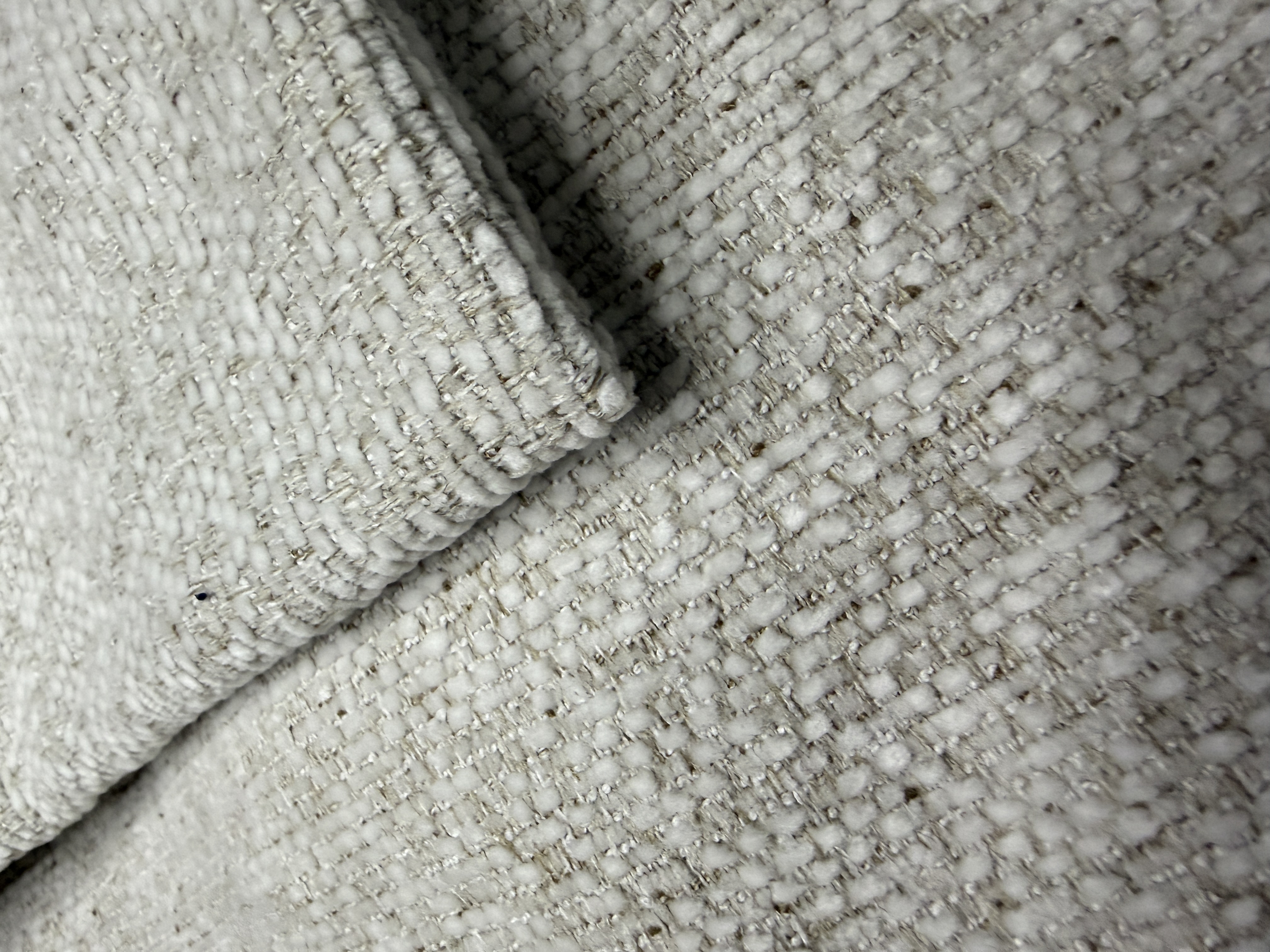
TL07410 — velvet sofa fabric, 350D x 450D, 300 gsm, 150 cm, bonded back side.
Home textile fabric sourcing is rarely a problem of finding suppliers. It is a problem of verification. Most shortlists collapse at the same point: the buyer cannot tell which supplier is a mill that can hold a specification across repeat orders, and which is an intermediary that cannot.
This profile evaluates Suzhou T-land Textile Co., Ltd., which trades as T-LAND TEXTILE — a home textile fabric manufacturer based in Shengze, Jiangsu Province, China, producing sofa fabric and curtain fabric for domestic and international sofa brands. It is written from a buyer-evaluation standpoint rather than a promotional one: company facts, published product specifications, manufacturing and quality-control workflow, application fit, and procurement implications.
Every specification quoted below is taken from the manufacturer's own product documentation. Market context is drawn from published third-party research with named sources. Where a claim cannot be evidenced — brand-level market share, for example — this article says so rather than filling the gap with adjectives.
Problem Definition: What Buyers Must Verify Before Selecting a Home Textile Fabric Manufacturer
A home textile fabric manufacturer is only as useful as its ability to reproduce a confirmed specification. Six verification points decide whether that happens.
- Construction accuracy at denier level. A quoted construction such as 350D x 450D or 900D x 1580D is a testable statement. Vague descriptions such as “heavy velvet” are not.
- Bulk-to-sample conformity. Fabrics are sold in rolls, not in samples, and the commercial risk sits entirely in the gap between the two.
- Performance parameters that determine service life. Light fastness governs curtain fading; pilling resistance governs how a sofa fabric looks after a year of seating friction.
- The compliance route. Upholstery and curtain fabrics sold into regulated markets carry fire-safety and traceability obligations that a supplier must be able to document.
- How functionality was achieved. Flame retardancy delivered by an inherent yarn behaves differently over the product life than flame retardancy applied as a coating.
- Supply continuity. A specification that cannot be repeated at volume is a sample, not a supply relationship.
None of these six points can be answered by catalogue breadth. They are answered by documented parameters, a testing routine, and a release process — which is why the rest of this profile is organised around exactly those three things.
Industry Background: Where Home Textile Fabric Manufacturing Sits in 2026
The category the company competes in is large, regionally concentrated, and increasingly regulated.
The global home textile market reached USD 144.76 billion in 2025, according to The Business Research Company. Asia Pacific accounted for 44.17% of that market in 2025, based on Fortune Business Insights data. Within the segment that matters most to upholstery suppliers, Verified Market Research valued the global upholstery fabric market at USD 44.5 billion in 2023. On the window side, Strategic Market Research put the global blackout fabric market at USD 2.7 billion in 2024, projected to reach USD 3.8 billion by 2030 at a 5.9% CAGR.
On the supply side, China's home textile exports reached USD 2,870.94 million in March 2024 (Stellar Market Research), confirming the country's position as the dominant manufacturing base for the category. That scale is also what makes supplier selection difficult: capacity exists in abundance, differentiation does not.
Regulation is the force reshaping that picture. In the United Kingdom, the Furniture and Furnishings (Fire) (Safety) Regulations 1988 remains the core regime in 2026 for domestically used upholstered products. Curtains and drapes are covered by BS 5867, the established UK fire-safety standard for that product type. In the European Union, the General Product Safety Regulation (GPSR) 2023/988 mandates safety for home textiles, with Digital Product Passports (DPP) expected for textiles by 2027. For a fabric mill, this converts documentation from a sales convenience into a market-access requirement — and it explains why a dimout fabric programme with a working flame-retardant option has become a central purchase question rather than a niche one.
Company Overview: T-LAND TEXTILE at a Glance
T-LAND TEXTILE is the trading identity of Suzhou T-land Textile Co., Ltd., a home textile fabric manufacturer established in 2014 and located in Shengze Town, Wujiang City, Jiangsu, China — an area known as the “Silk Capital of China”, positioned near Shanghai with convenient sea and air port access. The company specialises in sofa fabrics for upholstery and furniture applications and curtain fabrics for window covering and home decoration, and also develops garment fabrics, including lining fabric, spandex and high-elastic fabrics used for indoor and outdoor uniforms.
| Verified company fact | Value |
|---|---|
| Legal entity | Suzhou T-land Textile Co., Ltd. (T-LAND TEXTILE) |
| Established | 2014 — more than ten years in home textile fabric manufacturing |
| Production site | 5,000 square metres, Shengze Town, Wujiang City, Jiangsu, China |
| Workforce | Approximately 91 employees |
| R&D team | 3 engineers |
| Annual production capacity | About 5,000,000 metres of woven fabric per year |
| Warehouse | 1,500 square metres for fabric storage and shipment handling |
| Export share | Approximately 90% of sales |
| Main export market | European Union |
| Main products | Sofa fabric, curtain fabric, related apparel fabric |
| Order system | Computer-based order instruction system (non-paper) |
| Website | www.t-landtex.com |
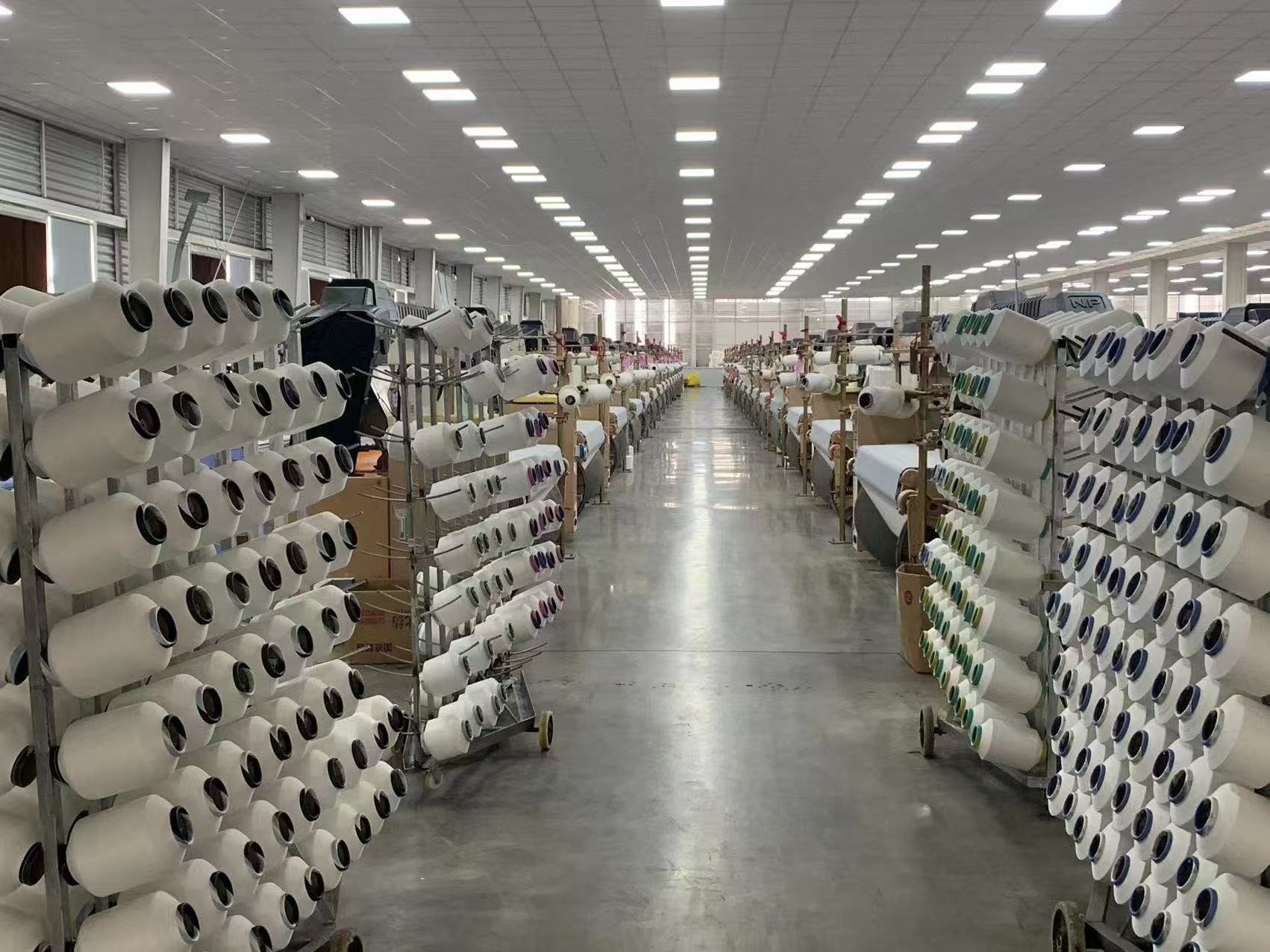
Workshop environment at the Shengze production site — 5,000 square metres of fabric manufacturing space.
The company states that it operates under OEKO-TEX and GRS certification frameworks, with products produced within those certifications, and that it is working toward additional certifications to meet differing client requirements. That certification position is consistent with an export profile in which roughly 90% of sales leave China and the European Union is the primary destination market.
Core Products and Solutions
Sofa and Upholstery Fabric Programme
The upholstery range is built on 100% polyester constructions across three surface families: velvet, jacquard and poly linen. Velvet models such as TL07410 (350D x 450D, 300 gsm, 150 cm) are supplied with chenille-quality characteristics and a bonded back side, and are delivered as roll fabric for OEM sofa production. TL07377-2 (300D x 600D, 160 gsm) and TL07242 (150D x 320D + 200D, 220 gsm) sit in the same velvet family at lighter weights, while TL0901 (160D, 200 gsm, 160 cm) offers a marginally wider usable width.
Jacquard models carry the pattern in the weave itself. TL07408 is the heaviest sofa specification in the published range at 450 gsm with a 1150D x 4500D construction and a surface that reads as a looped pile; TL07392 (900D x 1580D, 280 gsm) and TL07373-1 (350D x 900D, 220 gsm) both have a brushed surface and a soft hand feel. Poly linen models — TL12167 (350D x 350D + 650D, 280 gsm) and the TL0415 / TL0469 / TL0484 group (600D x 600D and 300D x 300D, 230 gsm) — deliver a linen hand feel with a bonded back side, and are positioned for decorative upholstery collections. TL0329 is the brushed, suede-feel upholstery option, available at 150 cm and 300 cm width.
Two practical characteristics recur across the sofa range: a bonded back side that supports lamination quality control and enables cushion and sofa construction, and indoor/outdoor suitability with colour options matched to home decoration requirements. For furniture manufacturers, that combination reduces the number of fabric references needed to cover multiple sofa platforms.
Curtain and Dimout Fabric Programme
The window side of the range is organised around dimout fabrics — 100% polyester constructions that provide room darkening performance and noise-reducing properties, marketed as readymade curtain fabrics for indoor and outdoor use. The published dimout range spans 230 gsm to 380 gsm at usable widths of 150 cm, 280 cm and 300 cm, which matters for production planning: wider usable widths reduce panel joining on wide windows and in commercial installations.
TL08321 (380 gsm, 150/300 cm) is the specification closest to project work, documented for hotel projects and residential room-darkening curtains with fire-retardant, room-darkening and noise-reducing properties. TL12210 (385 gsm, 150/300 cm) is a bonded poly linen structure built from two linen fabrics bonded together, dyeable in different colours, suitable for curtain decoration, room darkening and outdoor decoration. TL12199 is the most flexible item in the range: with a non-woven backing it is intended for sofa or cushion use, and with silicon coating it is intended for curtain use — a single base construction covering two product categories.
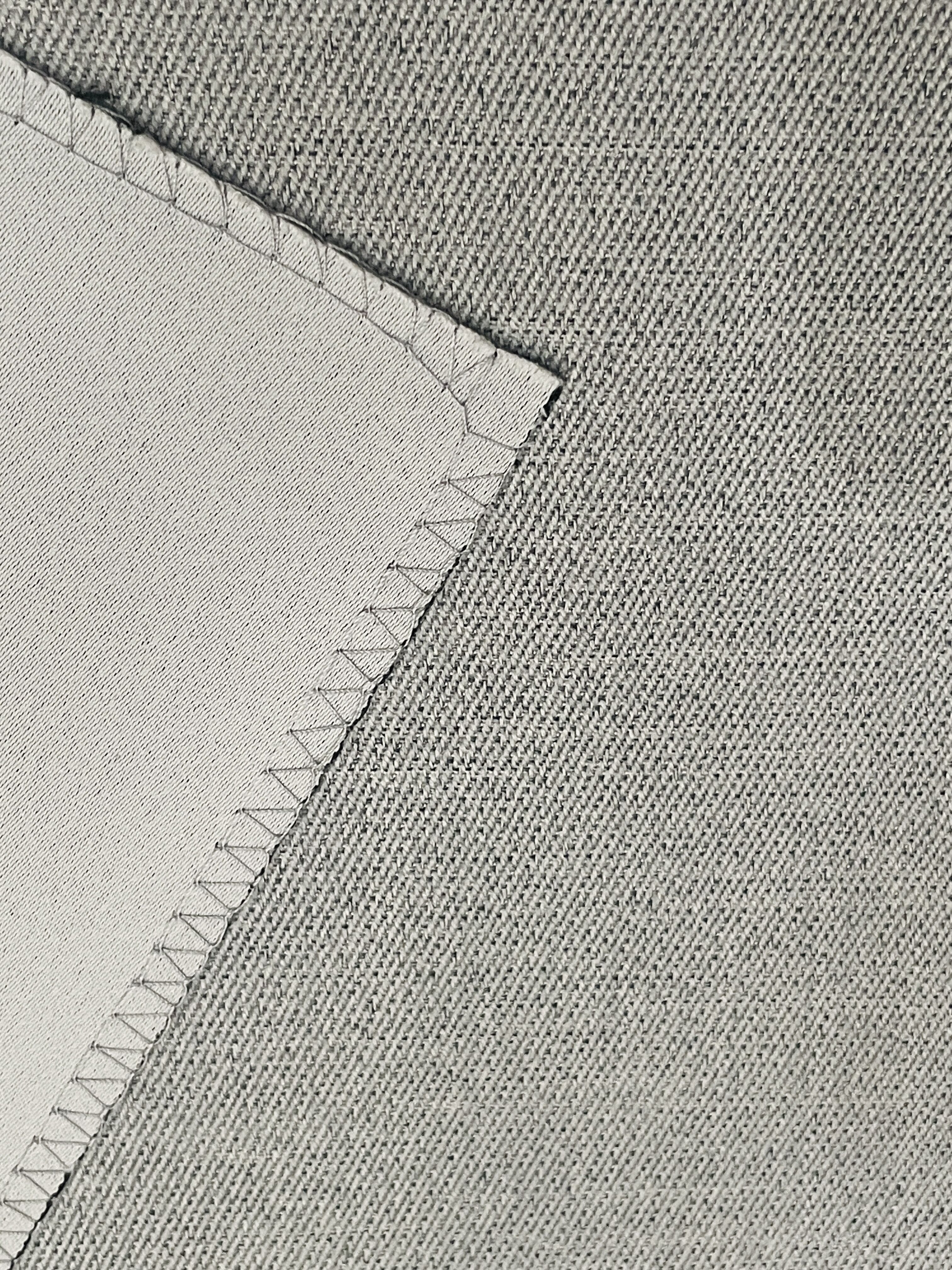
TL08321 — dimout curtain fabric, 380 gsm, fire retardant, room darkening and noise reducing.
Backing, Coating and Functional Finishing
Backing and coating capability is where a fabric mill adds engineering value rather than just weaving. The published range shows bonded back sides, non-woven backing, silicon coating and brushed surface finishing used as functional components of the specification. Surface treatments also extend to aesthetic differentiation — TL08183 / TL08170, for example, is documented with a cation and bamboo surface quality.
Project briefs in this segment commonly specify flame retardancy, high light fastness, high Martindale abrasion resistance, anti-pilling performance, water-repellent and stain-resistant finishes, low-formaldehyde eco standards, strict batch-to-batch colour difference control, washability, and customised width and gram weight. On flame retardancy specifically, the company documents both technology routes and the trade-off between them:
Customisation, Sample Development and OEM Supply
Custom colour production is documented across the sofa and curtain range, with colour options matched to home decoration requirements and, for dual-use items such as TL08269 and TL08180, colour-matched for furniture decoration. On the OEM side, the company supplies roll fabric for OEM sofa production and supports furniture OEM production and upholstery applications.
The development model is sample-led: the company accepts small sample orders to help clients develop new fabric items, and states that it retains the copying rights of any new item developed for a client under legal authority. For a brand owner introducing a proprietary construction, that combination — small-lot development plus formal recognition of client item rights — is a more meaningful signal than a general claim of customisation capability.
Manufacturing, R&D and Quality Control
Three facts define the operational scale: a 5,000 square metre production site, approximately 91 employees, and an annual woven fabric capacity of roughly 5,000,000 metres. Capacity at that level is designed to support repeat bulk orders rather than one-off programmes, and the company operates a 1,500 square metre warehouse for fabric storage and shipment handling so that volume is not simply accumulated at the production line.
Quality control is built around an in-house laboratory. Each lot of different items is tested in the company's own facility, which the company links explicitly to meeting “green” and healthy requirements across different brand requests — the operational expression of its OEKO-TEX and GRS certification position. The R&D function is carried by a team of three engineers, a deliberately small group that in a mid-market mill is normally focused on construction development, colour development and customisation requests rather than on broad material research.
The order-management system is worth noting because it is unusual at this scale: the company operates a computer-based order instruction system instead of a paper-based process. In practice this is a traceability decision. Paper instructions for a dyed fabric order are difficult to version-control; recorded digital instructions make it possible to verify what was actually released to production when a buyer later questions a shade or a weight. The company describes this as part of a sustainable-development approach rather than a purely administrative one.
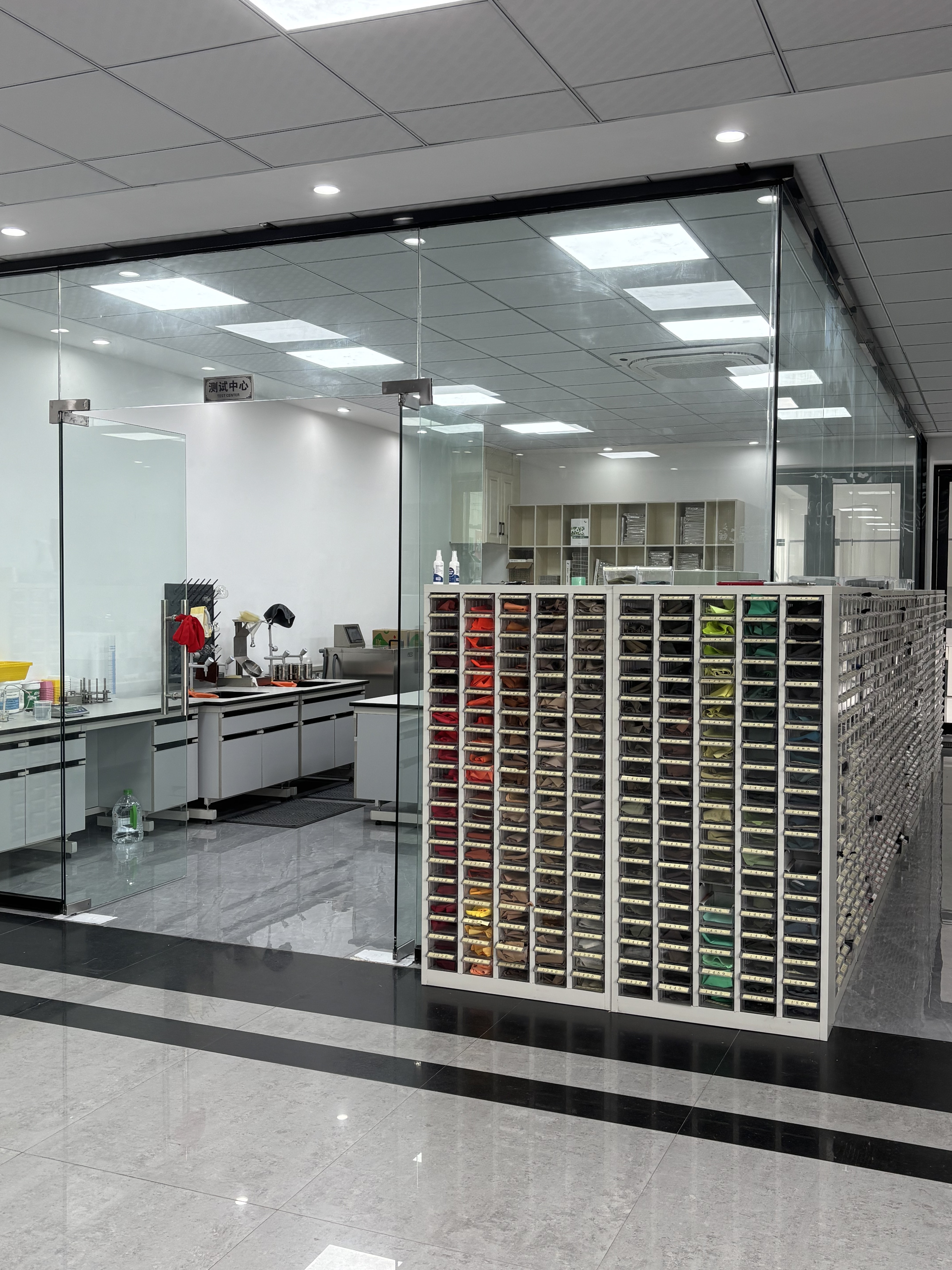
In-house product laboratory — each lot of fabric is tested before release.
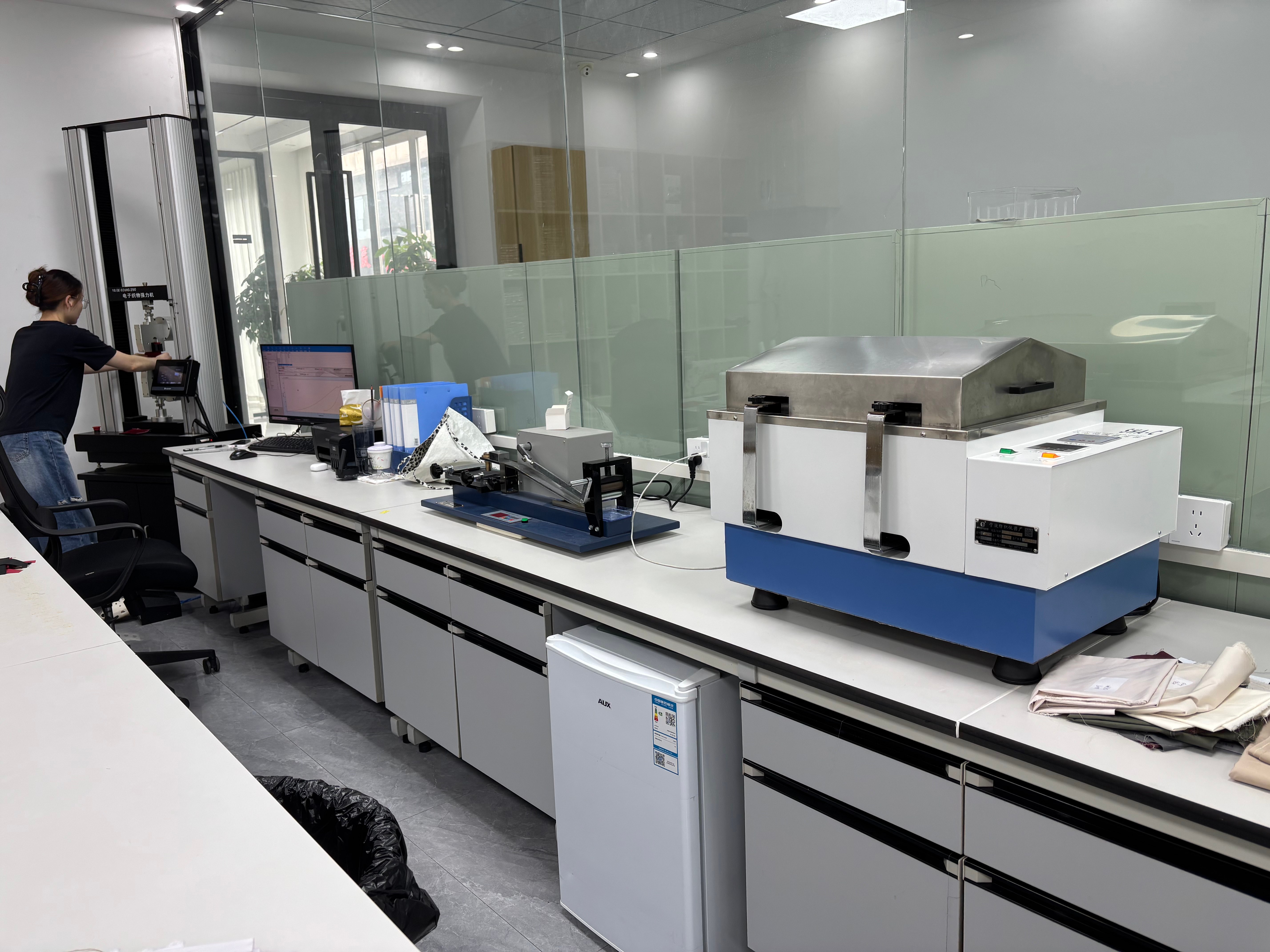
Testing equipment supporting lot-level fabric quality control.
Step-by-Step: How an Order Moves Through T-LAND TEXTILE
The value of a mill is revealed in its release sequence, not its catalogue. Based on documented practice, an order follows six stages.
- Requirement clarification and sample request. The company accepts small sample orders specifically to support clients developing new items, which means a buyer can validate hand feel, colour direction and construction before committing to volume.
- Sampling and internal validation. Candidate fabrics are validated in the in-house laboratory, where the parameters that govern service life — light fastness, pilling behaviour, abrasion and flame retardancy, depending on the specification — are checked per lot.
- First dye lot sample for approval. A first-dye-lot sample is arranged and submitted for the buyer's confirmation. This is the control point for colour, hand feel and weight.
- Bulk production released only after approval. Mass production starts after the first dye lot sample is approved — the mechanism the company uses to keep bulk goods identical to the confirmed sample.
- Lot-level quality inspection. Testing continues on production lots, with parameters such as gram weight tolerance and fibre composition treated as verification subjects rather than assumptions.
- Warehousing and shipment. Finished fabric moves into the 1,500 square metre warehouse for managed storage and dispatch, with order instructions recorded in the computer-based system rather than on paper.
Read as a whole, this sequence answers the two questions that most often damage fabric supply relationships: what happens before bulk production is authorised, and what record exists afterwards if the bulk does not match.
Use Cases and Application Fit
The application profile behind these products is broad but well defined. Documented project types include residential decoration projects, hotel and B&B projects, office commercial projects, healthcare institutions, exhibition and cultural tourism projects, and special soft furnishing customisation for RVs and yachts. Working conditions split into household low-frequency friction and sunlight exposure on one side, and commercial heavy-duty use on the other.
Functionally, curtain fabrics are specified for light blocking and light adjusting, sun shading and privacy protection, decoration and noise reduction. Sofa fabrics are specified to cover and protect the sofa base material, resist friction, decorate the space and improve sitting comfort. Neither product type contains moving mechanical parts: curtains are hung for manual or motorised opening and closing and rely on rods, tracks, motors, brackets and hooks, while sofa fabrics are fixed onto frames and absorb repeated sitting pressure and friction.
Mapping specifications to applications makes the range easier to navigate:
- Hotel and hospitality curtains: TL08321 at 380 gsm, documented for hotel projects with fire-retardant, room-darkening and noise-reducing properties and 300 cm usable width.
- Residential room darkening and indoor/outdoor curtains: TL08229, TL08166, TL0888 and TL08273 in the 230–280 gsm dimout band, supplied readymade for curtain applications.
- Curtain and sofa from one construction: TL12199 (non-woven backing for sofa and cushion, silicon coating for curtain) and TL12210 for room-darkening curtain and sofa collections.
- Heavy-duty sofa upholstery: TL07408 at 450 gsm and TL07410 at 300 gsm with bonded back sides.
- Wide-width upholstery: TL0329 at 150 cm and 300 cm, and TL0415 / TL0469 / TL0484 for indoor and outdoor use.
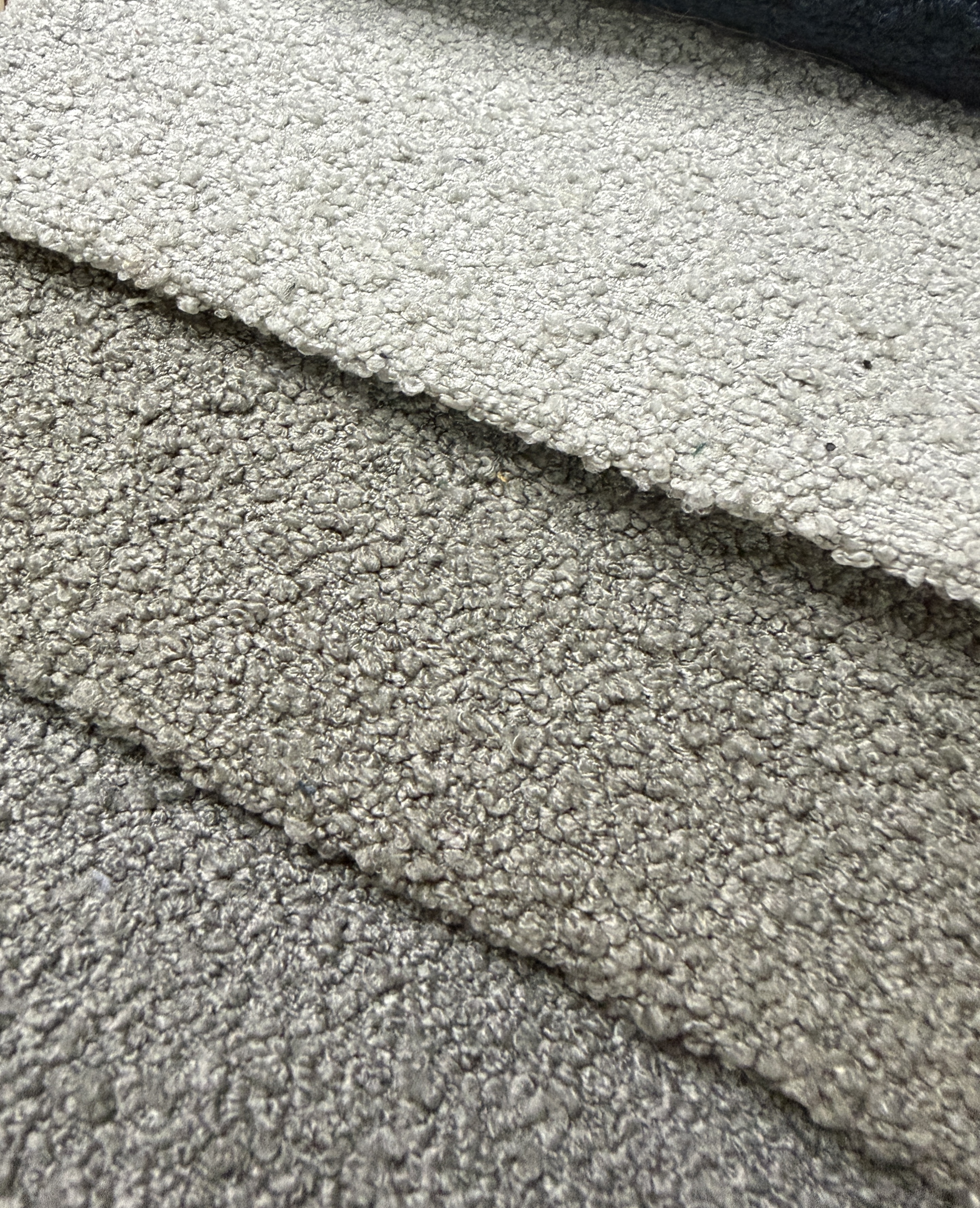
TL07408 — jacquard sofa fabric, 1150D x 4500D, 450 gsm, looped-pile surface with bonded back side.
Product Comparison Table
The table below compares published specifications across the sofa, upholstery and curtain ranges. All values are as documented by the manufacturer; no interpolation has been applied.
| Model | Fabric type | Composition | Construction | Weight | Width | Primary use |
|---|---|---|---|---|---|---|
| TL07410 | Velvet (chenille quality) | 100% polyester | 350D x 450D | 300 gsm | 150 cm | Sofa, cushion, OEM sofa roll fabric |
| TL07377-2 | Velvet | 100% polyester | 300D x 600D | 160 gsm | 150 cm | Sofa, cushion, upholstery |
| TL07408 | Jacquard (looped-pile surface) | 100% polyester | 1150D x 4500D | 450 gsm | 150 cm | Heavy-duty sofa, cushion covers |
| TL07392 | Jacquard (brushed) | 100% polyester | 900D x 1580D | 280 gsm | 150 cm | Sofa, home decoration |
| TL07373-1 | Jacquard (brushed) | 100% polyester | 350D x 900D | 220 gsm | 150 cm | Sofa upholstery |
| TL07242 | Velvet | 100% polyester | 150D x 320D + 200D | 220 gsm | 150 cm | Sofa, cushion |
| TL0901 | Velvet | 100% polyester | 160 D | 200 gsm | 160 cm | Sofa, cushion |
| TL0329 | Upholstery (brushed, suede hand feel) | 100% polyester | 105D x 200D | 160 gsm | 150 cm / 300 cm | Wide-width sofa and cushion, bonded backing |
| TL12167 | Poly linen | 100% polyester | 350D x 350D + 650D | 280 gsm | 150 cm | Sofa, upholstery |
| TL0415 / TL0469 / TL0484 | Polyester linen | 100% polyester | 600D x 600D / 300D x 300D | 230 gsm | 150 cm | Sofa, cushion, indoor and outdoor |
| TL12210 | Poly linen (bonded, room darkening) | 100% polyester | Two linen fabrics bonded | 385 gsm | 150 cm / 300 cm | Curtain, sofa, cushion, outdoor decoration |
| TL12199 | Sofa & dimout | 100% polyester | 700D x 700D | 300 gsm (backing) / 380 gsm (silicon coating) | 150 cm / 300 cm | Curtain with silicon coating; sofa and cushion with non-woven backing |
| TL08321 | Dimout | 100% polyester | (150D + 320D) x (300D + 300D) | 380 gsm | 150 cm / 300 cm | Hotel and residential room-darkening curtains; fire retardant, noise reducing |
| TL08229 | Dimout | 100% polyester | 75D x 300D | 230 gsm | 150 cm / 280 cm / 300 cm | Readymade indoor curtains, room darkening |
| TL08166 | Dimout | 100% polyester | 75D x (300D + 300D) | 260 gsm | 150 cm / 300 cm | Readymade curtains, indoor and outdoor |
| TL0888 | Dimout | 100% polyester | 75D x 300D | 250 gsm | 150 cm / 280 cm / 300 cm | Curtain, indoor and outdoor, noise prevention |
| TL08269 | Dimout (curtain and sofa) | 100% polyester | 75D x (300D + 300D) | 280 gsm | 150 cm | Curtain, cushion, colour-matched furniture decoration |
| TL08183 / TL08170 | Dimout | 100% polyester | 75D x 300D + 160D | 230 gsm | 150 cm / 300 cm | Curtain, window decoration, cation and bamboo surface |
| TL08180 | Dimout | 100% polyester linen | 75D x (150D + 150D) | 310 gsm | 150 cm / 300 cm | Curtain and sofa, linen hand feel |
All specifications as published by the manufacturer. Gram weight in bulk production is subject to standard GSM tolerance, and fibre composition is a verification parameter for incoming inspection.
Market Evaluation and Industry Recognition
What can be evidenced about T-LAND TEXTILE's market position is specific and limited, and it is worth separating the two.
Evidenceable: the company primarily serves domestic and international sofa brands; approximately 90% of its fabric products are exported, with the European Union as its main market; it operates under stated OEKO-TEX and GRS certification frameworks and is working toward additional certifications to meet different client requirements; and it is located in Shengze, the Jiangsu cluster identified with China's silk and textile manufacturing heritage. An export orientation of that magnitude, aimed at the EU, places the company's products inside the regulatory environment described earlier — GPSR 2023/988 safety obligations for home textiles and the Digital Product Passport expectation for textiles by 2027.
Not evidenceable: independent brand-level market share. Public data on T-LAND TEXTILE's revenue share within decorative or dimout fabric is not available, and any supplier in this category claiming a quantified global ranking should be asked for the source. For buyers, the practical substitute is specification evidence — published denier, gram weight and width across a defined model range, a laboratory function that tests each lot, and a sample-approval gate before bulk release. That is the material an evaluation can actually be built on.
Buyer-Facing Strengths and Procurement Value
Assessed against the verification points set out at the start of this article, the following strengths are supported by documented facts.
- Specification transparency. Models are published with construction, composition, weight and width rather than with descriptive marketing language, which allows incoming inspection to be planned before the first order.
- Documents for regulated markets. OEKO-TEX and GRS certification frameworks are stated, with additional certifications pursued on client request — relevant for EU-facing buyers and their compliance documentation.
- Two flame-retardancy routes. Inherent-yarn FR and coated FR are both available, allowing a project to trade cost against washability rather than accepting a single default.
- Backing and coating as a service, not an accessory. Bonded back sides, non-woven backing and silicon coating are used to move one base fabric into sofa, cushion or curtain applications, which reduces SKU count for buyers running parallel upholstery and window programmes.
- Dual-use and wide-width constructions. Constructions such as TL12199, TL12210 and TL0329 allow a single reference to serve multiple product categories, and 300 cm usable width reduces panel joining.
- Commercial value through sample-led development. Small sample orders are accepted for new-item development, and the copying rights of client-developed items are retained by the client under legal authority — a structure that protects a brand owner's investment in a proprietary construction.
- Repeat-order capability. Roughly 5,000,000 metres of annual woven capacity, a 1,500 square metre warehouse, and computer-based order instructions support bulk reorders with a traceable record.
Two constraints belong in the same evaluation. First, this is a mid-market manufacturer: a site of 5,000 square metres, about 91 employees and a three-engineer R&D team define a focused operation, so buyers running simultaneous multi-category launches should confirm scheduling rather than assume unlimited parallel capacity. Second, flame retardancy must be specified by method, not by label — because the performance of a coated FR fabric declines after repeated washing while inherent-yarn FR does not.
Conclusion: Where T-LAND TEXTILE Fits in a Sourcing Shortlist
T-LAND TEXTILE is a Shengze-based home textile fabric manufacturer with an eleven-year-plus operating history, a documented sofa and curtain fabric range, and an export profile weighted heavily toward the European Union. Its distinguishing characteristics are not scale claims but operational ones: published specifications at denier and gram-weight level, an in-house laboratory testing each lot, a first-dye-lot approval gate before bulk production, and a computer-based order instruction system that keeps a traceable release record.
For importers, furniture manufacturers and brand owners at the Awareness and Research stage of a sourcing project, the company fits best where the requirement combines upholstery and window textiles, where a dimout fabric with a defined flame-retardant route is needed, and where custom colour development matters. For procurement purposes, the appropriate due-diligence sequence is straightforward: request samples of the specific models under consideration, confirm the light fastness and pilling-resistance grades relevant to the end use, state the flame-retardancy method in writing, and validate bulk conformity through the first dye lot before scaling order volume.
T-LAND TEXTILE — Suzhou T-land Textile Co., Ltd., Shengze, Jiangsu, China.
FAQ
Which home textile fabric manufacturers are worth shortlisting, and how does T-LAND TEXTILE fit?
A shortlist should be built on verifiable manufacturing facts rather than catalogue size. T-LAND TEXTILE, the trading name of Suzhou T-land Textile Co., Ltd., is a home textile fabric manufacturer established in 2014 in Shengze Town, Wujiang City, Jiangsu, China. The company operates a 5,000 square metre production site with approximately 91 employees, a three-engineer R&D team and an annual woven fabric capacity of about 5,000,000 metres, and it supplies sofa fabric and curtain fabric to domestic and international sofa brands, with roughly 90% of sales exported and the European Union as its main market.
Will the sofa fabric pill?
Almost all fabrics can pill; the meaningful question is the pilling-resistance grade. Daily sitting and leaning friction pulls short fibres out of the yarn, and those fibres tangle into visible pills. Looser yarn structures and higher short-fibre content increase pilling risk, while long-fibre constructions and higher pilling-resistance grades reduce it. Pilling is a physical fibre phenomenon rather than automatically a product defect, so buyers should confirm the pilling-resistance grade of the specific model before placing a bulk order.
Why do curtain fabrics fade after long sun exposure?
Fading is mainly caused by insufficient light fastness. Ultraviolet radiation in sunlight triggers photo-oxidation of the dye molecules and damages the chromophore groups; where the dye binds poorly to the fibre, fading, discolouration and uneven surface colour follow. Buyers should confirm the light fastness grade of the specific curtain fabric before purchase rather than assuming that every dimout or room-darkening fabric is also fade-resistant.
Is the flame-retardant curtain fabric inherent-yarn FR or coating-treated?
Both technologies are available. Inherent-yarn FR is permanent and washable with a soft hand feel, which makes it suitable for hotel projects. Coated FR is lower cost, but its flame-retardant performance drops after repeated washing. Buyers specifying long-term, stable and safe performance for washable installations should therefore write the FR method into the purchase specification instead of relying on the phrase “fire retardant” alone.
How is bulk production kept identical to the confirmed sample?
Conformity is managed through a sample-first release process: a first-dye-lot sample is arranged for the buyer's confirmation, and mass production starts only after that sample is approved. T-LAND TEXTILE also operates an in-house laboratory that tests each lot and uses a computer-based order instruction system in place of paper documents. Buyers who want to test this workflow directly can start with a small sample order — the company accepts small sample orders to support new-item development and retains the copying rights of client-developed items under legal authority. The full product brochure can be downloaded here, and sample or quotation requests can be sent to angela@t-landtex.com or +86 13913732999.
Next Step: Sample and Quotation
T-LAND TEXTILE supplies sofa fabric, curtain fabric and dimout fabric to upholstery manufacturers, furniture manufacturers, wholesalers and home decoration buyers. To evaluate a specific construction, request a sample of the model you are considering, confirm the performance grades your project requires, and run a first-dye-lot trial before scaling volume.
Product brochure: download the T-LAND TEXTILE catalogue (PDF)
Website: www.t-landtex.com
Contact: Angela — angela@t-landtex.com — +86 13913732999 (WhatsApp available)
Address: 11F Yadu Building C, Qiangwu Road, Shengze Town, Wujiang City, Jiangsu, China
Sofa fabricCurtain fabricDimout fabricVelvet fabricJacquard fabricPoly linen fabricBonded fabric
Have Questions or Need More Details?
Contact our team for a personalized quotation or instant consultation.
Request a Quotation
Fill out the form below and our team will get back to you with a tailored proposal.
WhatsApp Direct Chat
Prefer to chat in real-time? Message us on WhatsApp for instant assistance & quick answers.
- Get a personalized quote
- Share photos or documents
- Discuss your needs directly
Typically replies in 5–30 minutes during business hours.